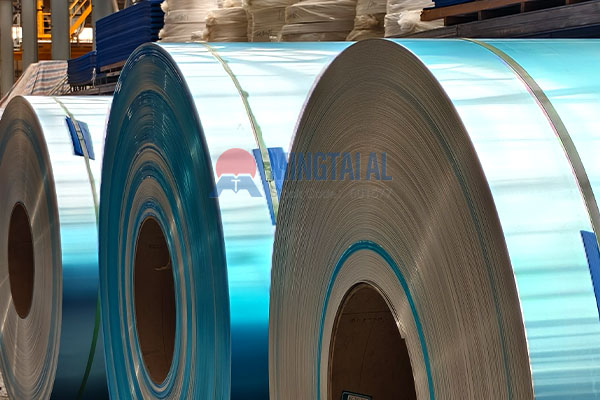
Aluminum Coil for Window Blinds
The production of window blind slats—from slitting and punching to bending and arc-forming—puts every roll of Aluminum Coil for Window Blinds to the test. If formability falls short, scrap rates rise, and in the worst case, entire batches are rejected. This is not an exaggeration; it happens daily in blind manufacturing facilities. Formability is not determined by a single factor but by a combination of alloy grade, temper, dimensional tolerances, and flatness—each playing a role in the final processing performance.
Alloy Selection: Beyond Strength
Choosing the right alloy is the first decision that affects forming behaviour.
3004 aluminium alloy is the most widely used choice for window blinds. It belongs to the Al-Mg-Mn series, offering higher strength than 3003 while retaining good plasticity and corrosion resistance. In the annealed condition it shows high ductility, and even after semi-hard working it still supports deep drawing and bending without cracking. Typical thicknesses range from 0.2 to 0.6 mm.
3104 aluminium alloy excels in deep-drawing performance, making it suitable for complex slat shapes. 5052 aluminium alloy, with higher magnesium content (2.2–2.8 %), provides superior strength—ideal for applications where robustness is a priority.
For less demanding uses, pure aluminium series (1050, 1060, 1100) and alloys like 3003 or 3105 are also available. They offer excellent formability but lower strength, so they are best suited for lightweight or decorative blinds.
O‑Temper vs. H‑Temper: A Critical Choice
The same alloy can behave completely differently depending on its temper. This is one of the most overlooked factors—and a common source of problems.
O‑temper (annealed)
- High ductility and plasticity
- Suitable for complex punching, deep drawing, and bending
- Lower strength compared to hardened tempers
H‑temper (strain‑hardened)
- Higher strength and stiffness
- Reduced ductility
- Better for simple forming operations
A quick rule of thumb:
- Complex shapes and multiple forming steps → choose O‑temper or lower H‑tempers (e.g., H12, H14)
- Simple profiles with higher strength requirements → choose H24 or H28
Dimensional Accuracy and Flatness: The Hidden Culprits
Tight thickness and width tolerances are essential. If the coil is not uniform, the formed slats will have inconsistent dimensions, and assembly issues become inevitable.
The industry standard YS/T 621‑2021 (Aluminium alloy strips and foils for window blinds) specifies technical requirements for these coils. Revised in 2021, it updated alloy designations, size ranges, tolerance limits, and tensile properties compared to the 2007 edition.
Flatness is equally important. Waves or warps in the coil lead to uneven deformation during stamping and bending, causing inconsistent curvature in the finished slats. A high‑quality coil should have a clean surface, free from oil spots, waves, scratches, and roll marks, with neatly trimmed edges and no burrs.
Common Formability Issues and Their Causes
These are the most frequent problems encountered in slat production—and they often trace back to the coil itself.
- Cracking during stamping. Insufficient ductility or an overly hard temper can cause cracks or even fracture. Aluminium’s low elastic modulus also leads to significant springback, making dimensional control tricky.
- Unstable arc curvature. Slats are pre‑curved to ensure tight closure when the blind is drawn. If the material’s mechanical properties are inconsistent or the flatness is poor, the final curvature varies from piece to piece, and the blind does not close properly.
- Surface defects. Non‑uniform ingot structure or coarse grains can produce surface blemishes. These not only affect appearance but also act as stress concentrators during forming, often triggering cracks.
Three Key Dimensions in Material Selection
When evaluating aluminium coil for window blind production, focus on these three aspects:
1. Define your product requirements clearly.
- Slat size determines the required thickness and width.
- Design complexity sets the formability threshold.
- Indoor or outdoor use defines the corrosion resistance needed.
2. Match alloy and temper to your process.
- For standard blinds, 3004 in H24/H28 is a reliable choice.
- For complex forming, prefer O‑temper or H12/H14.
- For high‑strength needs, consider 5052 or 3104.
3. Evaluate the supplier’s quality control.
- Are melting and casting processes stable?
- Can they maintain strict thickness and width tolerances?
- Is the flatness and surface quality consistently high?
Ultimately, formability is a systemic requirement—every link from alloy to temper to dimensional control affects the final product. Understanding these factors and matching them to the specific processing route is the first step toward controlling scrap rates and production efficiency. For reliable Aluminum Coil for Window Blinds, Mingtai Aluminum supplies 3004, 3104, and 3105 alloys, with order volumes ranging from 8 to 5,000 tons. For more information, feel free to reach out.
FAQ
Q1: Which alloy is most common for window blind coils?
A: 3004 aluminium alloy, because it balances strength, formability, and corrosion resistance well.
Q2: What is the difference between O‑temper and H‑temper, and how to choose?
A: O‑temper offers maximum formability but lower strength; H‑temper provides higher strength but reduced ductility—choose based on forming complexity.
Q3: What thickness range is typical for blind coils?
A: Usually 0.2–0.6 mm; thinner for small windows, thicker for large ones.
Q4: What causes cracking during forming?
A: Usually an overly hard temper, insufficient ductility, or internal structural defects in the material.
Q5: Is there a specific standard for blind‑use aluminium coil?
A: Yes, YS/T 621‑2021 is the dedicated industry standard for this application.