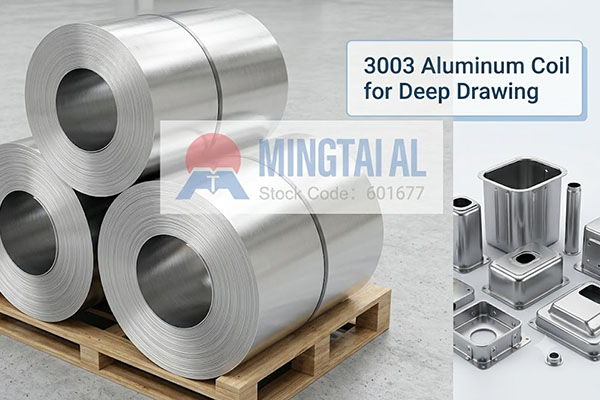
3003 Aluminum Coil for Deep Drawing
When deep‑drawing processes demand consistent material flow, uniform wall thickness, and defect‑free results, 3003 Aluminum Coil for Deep Drawing offers the ideal balance of workability, corrosion resistance, and post‑forming strength — without heat treatment.
Why 3003 Excels in Deep Drawing
The Al‑Mn alloy (1.0–1.5% manganese) provides two critical benefits: higher strength than 1100 aluminum while retaining high elongation. In the fully annealed (O) temper, elongation reaches 30% or more, allowing metal to flow deep into dies without cracking. The manganese addition boosts strength by approximately 20% compared to pure aluminum, making drawn parts more dent‑resistant.
3003 is non‑heat‑treatable — its temper defines performance. Fully annealed (O) delivers maximum drawability for complex, multi‑step draws, while half‑hard (H14) offers moderate formability with higher as‑formed strength.
Selecting the Right Temper
Choosing the wrong temper is a leading cause of cracking or springback. Use this quick guide:
|
Temper |
Best Use in Deep Drawing |
|
O (Annealed) |
Severe depth‑to‑diameter ratios, multi‑step draws |
|
H12 |
Light forming with improved stiffness |
|
H14 |
Medium‑complexity draws, balanced workability & strength |
|
H16 / H18 |
Minimal drawing; not recommended for deep draws |
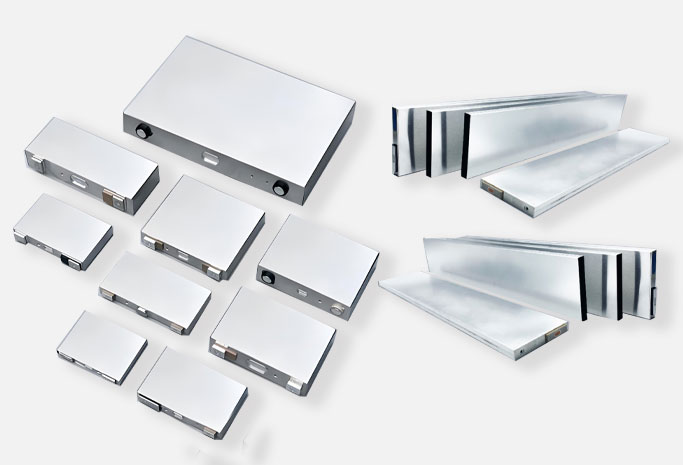
Tip: For single‑hit deep cavities, start with O temper. For parts needing post‑draw strength (e.g., battery housings), H14 is often the best compromise.
Common Defects & How to Avoid Them
- Edge cracking → Reduce blank holder force; check edge hardness from slitting.
- Arc‑zone tearing → Maintain die radius ≥ 4× material thickness; use quality lubrication.
- Earing (wavy top edges) → Target earing ratio ≤ 2.0; comes from coil texture.
- Excessive holder force → Cracks indicate too much force; wrinkles indicate too little. Adjust gradually.
Lubrication Best Practices
Lubrication dramatically affects success rates. For 3003 aluminum coil:
- Use chlorine‑free, aluminum‑specific drawing compounds.
- For severe draws, apply heavy‑duty paste or film lubricants.
- Coat both sides of the blank evenly to avoid localized tearing.
- Automatic mist applicators ensure consistent film thickness in progressive dies.
Good lubrication also reduces galling and extends die life.
Surface Treatment Compatibility
- Anodizing: 3003 anodizes well, but harder tempers (H14) may show slightly duller color. For decorative anodizing, choose O or H12 temper.
- Powder coating / painting: Excellent adhesion and uniform surface; pre‑treatment (conversion coating) further improves performance.
Alloy Comparison: 3003 vs. 1100 and 5052
|
Alloy |
Formability |
Strength |
Best Application |
|
1100 |
Excellent |
Very low |
Pure deep‑drawing where final strength isn’t critical |
|
3003 |
Very good |
Medium‑low |
Deep‑drawn parts needing dent resistance |
|
5052 |
Moderate |
Medium‑high |
Structural / marine uses (needs annealing) |
Choose 3003 when you need a versatile drawing alloy that outperforms 1100 for impact resistance and is easier to draw than 5052.
Die Design Tips for 3003 Aluminum Coil
Tooling geometry directly influences draw depth and surface quality. For 3003 Aluminum Coil for Deep Drawing in O temper, these parameters are recommended:
- Punch radius ≥ 4× material thickness
- Die radius = 6× to 8× thickness for first draw
- Clearance = 1.07× to 1.10× thickness per side
- Blank holder surface polished to ≤ 0.4 µm Ra
Following these guidelines reduces scrap rates and allows deeper draws without intermediate annealing.
Standards & Certifications
Always source material meeting:
- ASTM B209 / EN AW‑3003 / ISO 6361 / AMS‑QQ‑A‑250/2
Reputable suppliers provide mill test reports (MTRs) confirming composition, properties, and temper.
For consistent deep‑drawing results, Mingtai Aluminum delivers reliable 3003 aluminum coil solutions tailored to your specifications. Contact us to discuss your project requirements.
FAQ (Concise)
Q1: Can 3003 be used for very deep draws (depth > diameter)?
Yes, in O temper. With proper die design (R ≥ 4t) and lubrication, depth‑to‑diameter ratios >1.5 are achievable.
Q2: Does 3003 anodize evenly after deep drawing?
Yes, but H14 may show slightly duller color. For uniform anodizing, use O or H12.
Q3: What temper for battery enclosure deep drawing?
3003‑O for complex multi‑step draws; 3003‑H14 for simpler shapes where post‑draw strength matters.
Q4: 3003 vs. 5052 — which is easier to deep draw?
3003 is significantly easier (higher elongation). 5052 often requires intermediate annealing.
Q5: What thickness range is typical?
0.3 mm to 3.0 mm, widths up to 2650 mm.
Q6: Can 3003 be welded after drawing?
Yes (TIG, MIG, resistance). Use filler 4043 or 5356.