aluminum plate internal stress control
A Problem Worth Addressing Before Machining
When a plate is received and machined with precise dimensions, it may warp after the clamps are released. This is not uncommon. The issue is rarely with the equipment; it lies in the residual stress locked inside the plate. Once that stress is released during cutting, distortion follows.
The core logic is straightforward: the level of *aluminum plate internal stress control* directly determines whether deformation will occur in subsequent operations like cutting and milling.
Where Does Internal Stress Come From?
To address the issue, start with the root causes.
① Rolling stage
Severe deformation during rolling creates uneven strain through the thickness, which already forms residual stresses inside.
② Quenching stage (the main source)
For heat‑treatable alloys such as 2xxx, 6xxx, and 7xxx series, solution heat treatment is followed by rapid water cooling. The outer layers cool and harden first, while the interior cools later. This temperature gradient generates balancing tensile and compressive stresses across the cross‑section.
The critical point:
As long as the plate remains intact, these stresses are in equilibrium. Once material is removed, the balance breaks, and warpage occurs.
How to Evaluate the Effectiveness of Stress Control?
Detection capability sets the upper limit of quality control. The following three approaches each have their own emphasis:
1. Verification by machining (most intuitive) – Run a trial batch after receiving the plate and observe the amount of distortion. This is a post‑check; it can identify problems but cannot prevent them.
2. Non‑destructive testing (more scientific)
- Short‑wavelength X‑ray diffraction can non‑destructively measure the residual stress distribution inside the plate.
- Ultrasonic testing based on critically refracted longitudinal waves also provides effective measurement of internal stresses.
3. Numerical simulation (for predictive analysis) – Use finite element software to simulate the quenching and pre‑stretching processes, predicting residual stress distribution before production and allowing early optimisation of process parameters.
Key Points to Consider When Selecting Material
When comparing plates from different suppliers, the following aspects are worth attention:
- Temper designation – T6 means solution treatment plus aging, with relatively high internal stress. T651 adds pre‑stretching on top of T6, resulting in less machining distortion. For applications that involve subsequent machining, T651 is the preferred choice.
- Supplier’s process capability – Does the supplier have a large‑tonnage stretcher? Is there a precise stretch‑control system? Are stress‑measuring devices available? All these directly affect the final stress level of the product.
- Validation in end‑use industries – Industries such as aerospace and semiconductor equipment have strict standards for internal stress in aluminium plates. Products that have passed verification in these sectors tend to be more reliable.
Primary Methods for Precise Stress Control
The most widely adopted and reliable method in the industry is pre‑stretching (mechanical stretching).
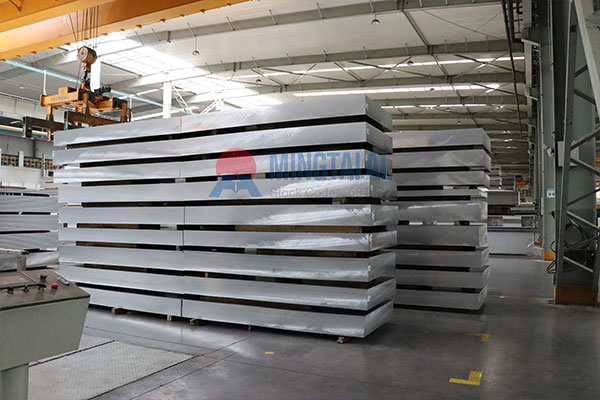
After solution heat treatment and quenching, a controlled tensile force is applied to the plate, inducing a certain amount of permanent plastic deformation. This process enables the residual stresses along the thickness direction to counteract each other. Precise setting of the stretch amount is critical – too little leaves stress inadequately relieved, while too much may compromise material properties.
Plates that have undergone pre‑stretching stress relief carry designations like “T651” (e.g., 6061‑T651, 7075‑T651) in the temper code. This is an important reference when selecting material for subsequent processing.
Beyond pre‑stretching, there are also complementary methods:
- Thermal aging – Holding at a specific temperature allows stress to be released through micro‑plastic deformation.
- Cryogenic treatment – Using liquid nitrogen to create rapid cooling and reheating, so that thermal stress offsets residual stress.
- Vibration stress relief – Applying controlled vibration to the plate at specific frequencies to reduce internal stresses.
Each method has its applicable scenarios, but pre‑stretching remains the core step for *aluminum plate internal stress control*.
Core Insight
Stress control is not an optional add‑on but a fundamental requirement for aluminium plate quality. From rolling to quenching, from pre‑stretching to inspection and verification, precise control at every stage directly influences the success or failure of subsequent machining. Choosing plates with adequate stress control means lower scrap rates, less rework cost, and more consistent product quality.
*Henan Mingtai Aluminum has accumulated extensive experience in aluminium plate internal stress control, offering reliable product options for users with precision machining needs.*
FAQ
Q: Is warpage after machining a material problem or a processing problem?
A: In most cases, it is caused by the release of residual stress in the material – an issue of stress control.
Q: What is the difference between T6 and T651?
A: T651 adds pre‑stretching to relieve internal stress on top of T6, resulting in less deformation during machining; choose T651 when further processing is required.
Q: Can pre‑stretching completely eliminate internal stress in aluminium plates?
A: No, but it can reduce stress to very low levels, sufficient for most precision machining requirements.
Q: If a plate has good stress control, will it never warp during machining?
A: It greatly reduces the risk, but final distortion also depends on machining parameters such as cutting depth, feed rate, and clamping method.