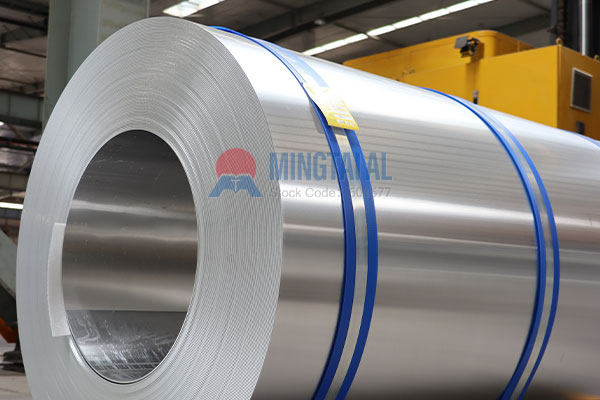
aluminum coil for lamp cap
Choosing the right aluminum coil for lamp cap stamping is critical—not every alloy delivers the balance of strength, formability, and cost that this specific application demands. Among the many options, 3105 stands out as a practical, proven choice.
What exactly is 3105?
It is an Al-Mn alloy from the 3xxx series, containing roughly 0.30–0.80% manganese and 0.20–0.80% magnesium, with about 98% aluminium. This composition is deliberate: compared to 1100 (pure aluminium), 3105 gains noticeable strength from manganese and magnesium. Compared to 5052, it has far less magnesium, so it remains easier to form. It was not designed to be the strongest alloy—it was designed to be the most balanced. And lamp cap stamping thrives on balance.
Four critical requirements – and 3105 meets every one
Strength
Lamp caps must withstand tightening torque and clamping forces during assembly and use. If the material lacks strength, threads deform and caps crack. 3105 offers tensile strength ranges from about 110–155 MPa in O temper to 150–200 MPa in H14 temper. This provides enough structural stability without making subsequent processing difficult.
Formability
Stamping involves blanking, piercing, drawing, and thread rolling. 3105 in O temper (fully annealed) delivers excellent deep‑drawing performance for complex shapes; in H24 (partially annealed) it balances strength and ductility, ideal for shallower draws and thread forming. Cracking is rarely an issue under proper process conditions.
Corrosion resistance
Lamp caps may be exposed to humidity or varying environmental conditions over time. 3105 naturally forms a dense oxide layer that performs well in atmospheric and general industrial environments, ensuring long‑term reliability.
Cost efficiency
Compared to higher‑magnesium alloys like 5052, 3105 is less expensive to produce. Its strength also allows thinner gauges than 1100 for the same load requirements, offering tangible savings in high‑volume production.
How does 3105 compare with common alternatives?
|
Alloy |
Strength |
Formability |
Corrosion resistance |
Cost |
Suitability for lamp caps |
|
1100 |
Low |
Excellent |
Good |
Low |
Lacks strength – prone to deformation |
|
3003 |
Medium |
Excellent |
Good |
Medium |
Good but slightly weaker than 3105 |
|
3105 |
Medium‑high |
Excellent |
Excellent |
Medium |
Best overall balance |
|
5052 |
High |
Good |
Excellent |
High |
Harder to form – more tool wear |
Among these, 3003 and 3105 are often the two real candidates. If formability is the absolute top priority, 3003 is a fine choice. But for lamp caps, where a little extra strength makes a real difference in thread integrity and wall stability, 3105 consistently delivers better results with almost no trade‑off in formability.
Choosing the right temper for your process
3105 coils are available in several tempers, each suited to different stamping requirements:
- O (fully annealed) – maximum ductility for deep drawing and multi‑step forming.
- H24 (work‑hardened and partially annealed) – balanced strength and formability for shallow drawing and thread rolling.
- H14 / H16 (higher work‑hardened levels) – progressively higher strength for simpler shapes or when post‑stamping stiffness is critical.
This flexibility means the same alloy can serve a wide range of lamp cap designs—from simple bayonet types to complex screw‑base geometries.
How 3105 performs through the stamping line
A typical lamp cap production line includes: coil feeding → blanking → drawing → thread rolling → trimming. Throughout this sequence, 3105 demonstrates consistent behaviour:
- Feeding – good flatness and tight thickness tolerances ensure smooth automatic feeding.
- Blanking and drawing – excellent ductility reduces scrap and tool wear.
- Thread rolling – moderate hardness allows sharp, clean threads without excessive roll wear.
These characteristics translate to fewer interruptions, longer tool life, and more predictable output—factors that directly affect production efficiency.
The requirements for lamp caps may seem small in scale, but they are comprehensive. 3105 aluminium coil earns its preference not by excelling in any single property, but by having no weak link—strength that supports, formability that flows, corrosion resistance that endures, and cost that makes sense. That is why the 3105 aluminum coil for lamp cap stamping has become a go‑to material for manufacturers who value reliability and consistency.
Henan Mingtai Aluminum supplies 3105 coils with stable alloy composition and precise thickness tolerances, providing a solid base material for lamp cap stamping. We do not offer anodising, coating, or any surface‑finishing services—our focus is on delivering high‑quality bare coils that you can process further according to your own specifications.
FAQ
Q1: What is the main difference between 3105 and 3003 for lamp cap stamping?
A: 3105 has higher strength than 3003 due to its magnesium addition, while retaining very similar formability.
Q2: Can 3105 handle all types of lamp cap designs?
A: Yes—by selecting the appropriate temper, 3105 accommodates deep‑drawn, shallow‑drawn, and threaded designs.
Q3: How corrosion‑resistant is 3105 in real use?
A: It forms a protective oxide layer that resists atmospheric and mild industrial corrosion effectively.
Q4: Does 3105 tend to crack during stamping?
A: No—its good ductility and plasticity make cracking uncommon under normal stamping conditions.
Q5: Does Mingtai Aluminum offer surface treatment for 3105 coils?
A: No, we supply bare 3105 coils only; surface finishing is left to your own processing chain.