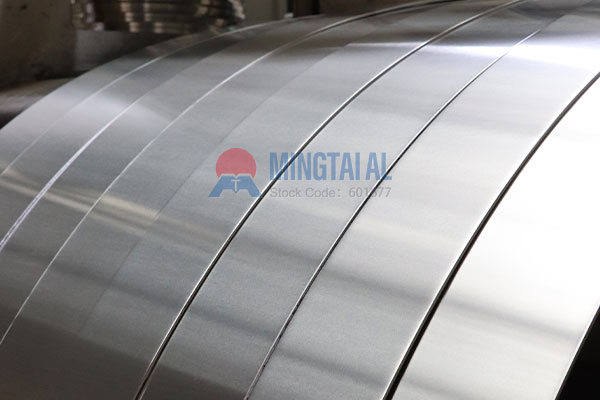
aluminum strip for flex duct
For flexible duct manufacturers, the real question isn't which alloy to choose—it's whether the aluminum strip for flex duct will hold up through continuous spiral winding without cracking, wrinkling, or losing its shape. The answer comes down to a few measurable formability specs, and this guide walks you through each one.
Alloy Selection – Why 8011 Dominates
Common alloys include 8011, 1100, 1200, and 3003. Among these, 8011 is the most widely used for flexible duct applications.
- 8011 contains Al ≥ 98.5% with Fe (0.6–1.0%) and Si (0.5–0.9%) to form dispersion-strengthening phases.
- Compared to 1100 pure aluminum, 8011 offers about 35% better tear resistance and 28% higher peel strength at seams.
- 1xxx series lacks strength and deforms easily, while 3003 is too hard and tends to crack at joints.
- 8011 strikes an optimal balance between strength and formability.
Temper States – Soft vs. Hard
The temper state directly affects forming difficulty and final duct rigidity.
- O temper (fully annealed): Internal stress is fully relieved, giving maximum ductility. For 8011‑O, elongation reaches over 25% and tensile strength is around 80–120 MPa. Ideal for large‑diameter, large‑pitch ducts – low forming resistance and good seam sealing, but lower radial stiffness.
- H22 temper: Partial annealing gives intermediate hardness. Tensile strength 100–130 MPa, elongation ≥ 12%. Performs well in stretch forming processes.
- H24 temper: The balanced choice – tensile strength 140–180 MPa, elongation 12–16%. Ducts retain round cross‑section without collapse. This is the mainstream option for semi‑rigid ducts.
- H26 temper: Higher strength (180–220 MPa) suits high‑pressure systems or small‑diameter ducts, but requires more precise forming equipment.
Thickness – From 0.06 mm to 0.20 mm
Typical thickness ranges from 0.06 mm to 0.20 mm. The choice depends on service conditions:
- 0.06–0.08 mm – for low‑static‑pressure HVAC systems, balancing flexibility and cost.
- 0.10–0.12 mm – common in fresh‑air systems, offering a good trade‑off between strength and elasticity.
- 0.13–0.15 mm – for industrial exhaust, providing enhanced resistance to negative pressure.
Thinner strips are more flexible but lower in compressive strength and durability. Always select thickness based on duct diameter and working pressure. Thickness tolerance is typically controlled within ±3%.
Width – Matching Production Lines
Width ranges from 50 mm to 1000 mm, with common sizes like 60 mm, 80 mm, etc. Custom widths are available via slitting. The right width depends on duct diameter and the specific forming equipment used.
Mechanical Properties – Three Key Indicators
Three measurable values are crucial for evaluating formability:
- Elongation – reflects plastic deformation capacity. O temper requires ≥ 25%; H24 temper offers 12–16%.
- Erichsen cupping value – measured by the Erichsen cupping test, it indicates the material’s ability to undergo stretch forming. For H22, ≥ 5.5 mm; for H24, ≥ 5.0 mm.
- Tensile strength – O temper: 80–120 MPa; H24: 140–180 MPa.
Different Forming Processes Have Different Needs
- Stretch forming – slower speed, requires good deep‑drawing ability. Thickness is usually above 0.11 mm.
- Thinning stretch forming – faster speed, thickness below 0.11 mm, needing both plasticity and adequate strength.
When selecting specifications, start by clarifying the duct application (HVAC fresh air / industrial exhaust), working pressure, and required bending radius, then work backward to determine the alloy, temper, and thickness combination.
*We supply bare aluminum strip without any surface coating or further processing – our focus is purely on high‑quality substrate material.*
Choosing the Right Supply Partner
A reliable source of aluminum strip for flex duct should offer consistent mechanical properties, tight thickness tolerances, and flexible temper options. Mingtai Aluminum provides a full range of products for flexible ducting, supporting O, H22, H24, and other tempers with customised widths. For technical support or sample requests, feel free to reach out.
FAQ
Q: Which alloy and temper are most commonly used for flexible duct strips?
A: 8011 alloy with O or H24 temper – H24 offers 140–180 MPa tensile strength and 12–16% elongation, making it the top choice for semi‑rigid ducts.
Q: How does thickness affect flexible duct performance?
A: Thinner strips are more flexible but weaker; 0.10–0.12 mm balances strength and elasticity, while 0.06–0.08 mm suits low‑pressure systems and 0.13–0.15 mm works for industrial exhaust.
Q: What is the Erichsen cupping value and why does it matter?
A: It measures a sheet’s stretch‑forming capability – a higher value indicates better ductility and lower risk of cracking during complex forming operations.