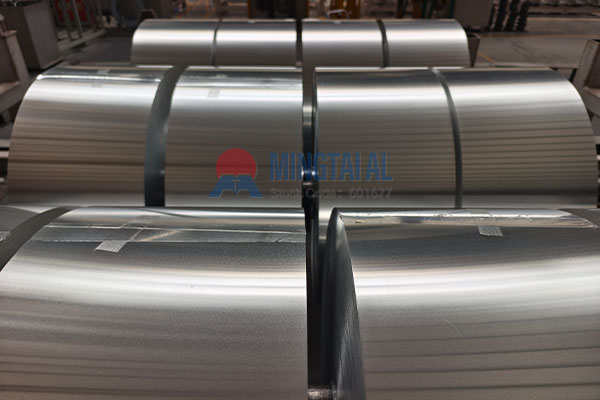
8011 h22 aluminum foil
Semi-rigid containers sit between flexible packaging and rigid trays. They need a material that holds its shape after stamping, yet still forms without cracking. 8011 H22 aluminum foil is often chosen for this middle ground.
Start with Temper, Then Alloy
8011 is an Al-Fe-Si alloy. Iron and silicon form fine compounds that help raise strength while preserving ductility.
But temper often decides forming performance.
H22 means light cold work hardening.
- Harder than O temper, so the container keeps its shape better after stamping.
- Softer than H18, so the risk of cracking in complex shapes is lower.
- Flat sheet with stable shape, suitable for continuous die production.
The “22” refers to the degree of work hardening. Compared with H24 and H26, H22 is less hardened and keeps more ductility. That makes it a better fit for semi-rigid stamping with some deformation, rather than lids or gaskets where rigidity is the main goal.
In short: H22 is not the softest or the hardest. It puts “can form” and “can support” in the same material.
Three Tensions in Semi-Rigid Stamping
1. Formability: enough ductility to avoid cracks during stamping.
2. Shape retention: enough stiffness to resist deformation after filling.
3. Consistency: stable behavior in continuous production, with less batch-to-batch variation.
A simple table shows the difference among O, H22, and H18:
|
Temper |
Formability |
Shape retention |
More common direction |
|
O |
Strong |
Weak |
Deep drawing, complex shapes, often needs external support |
|
H22 |
Balanced |
Balanced |
Medium-depth, regular semi-rigid containers |
|
H18 |
Limited |
Strong |
Rigidity-first, low-deformation parts |
H22 does not replace O or H18. It covers the middle ground. Most semi-rigid trays and containers do not need the extreme ductility of O temper, but they need more deformation than H18 can offer. H22 fits that range, so many forming lines use it as a standard choice.
If the stamping shape is moderately complex and the container needs to support itself, H22 is often the first option to consider.
Where H22 Is Often Used
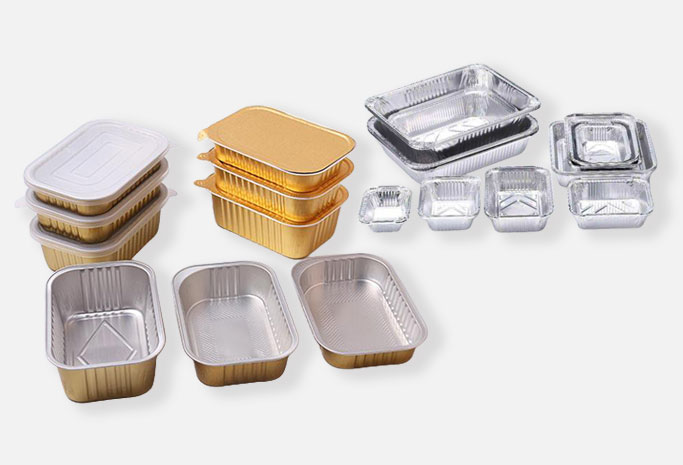
- Food containers and airline trays
- Takeout boxes, baking trays, frozen food containers.
- Airline catering trays need weight reduction, structural rigidity, and compatibility with heat-seal lids.
- In multi-cavity continuous stamping, sheet flatness and mechanical consistency directly affect demolding and yield. Large batch variation can cause local thinning or uneven edges.
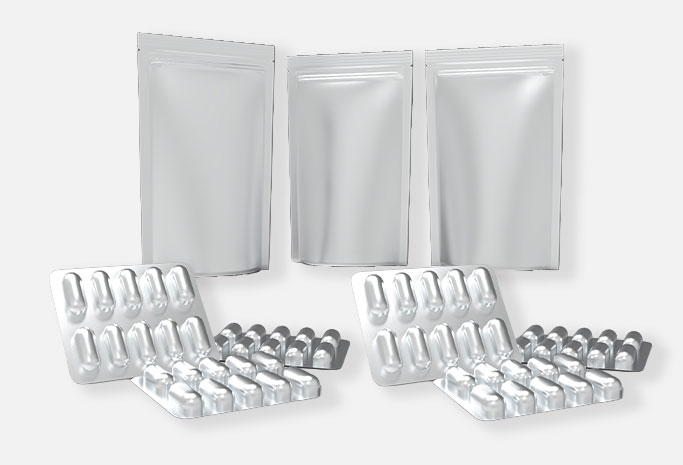
- Pharmaceutical blister packaging (PTP)
- H22 has good cold-stamping formability and can form blister pockets of a certain depth.
- The foil itself offers strong barrier performance, helping protect tablets from moisture and oxidation.
- Other formed parts
- Caps, sealing gaskets, easy-open ends, and similar parts.
The common thread: the material needs stable stamping behavior within a certain thickness range, and it should not spring back or distort after forming.
> Note: As a base material supplier, we do not provide surface treatment or further processing. Coating, printing, and lamination are usually completed later by the forming processor.
Questions to Ask Before Selection
1. How deep and complex is the stamping?
The more complex the shape, the more ductility matters.
2. Does the container need to support itself?
If yes, H22 is often a better fit than O temper.
3. Will there be heat sealing, printing, or lamination later?
These steps affect the surface quality requirements for the base material.
4. Is batch consistency under control?
The smaller the variation in mechanical properties, the more stable continuous stamping becomes.
5. Do die clearance and stamping speed match the material?
Different tempers tolerate different die clearance and speed. H22 often allows a faster cycle than O temper, but needs gentler deformation conditions than H18.
These questions usually matter more to final yield than price alone.
Trial Stamping Beats a Data Sheet
Before mass production, trial stamping is the most direct verification method.
- Check whether the edges are clean.
- Look for wrinkles or cracks.
- Confirm whether the part springs back after demolding.
- Check thickness and surface quality.
After trial stamping, also check thinning in the stamped area. Excessive thinning often means the material lacks ductility or the die clearance is too small. In that case, adjust the process or reconsider the temper.
> The mold and the process will tell you whether the material is right.
What This Means for Your Forming Line
The value of 8011 H22 aluminum foil in semi-rigid stamping is not “the strongest,” but “the balance.” Understanding where that balance works will make selection much clearer.
If you are evaluating base material specifications and batch stability, Henan Mingtai Al. can provide customized production and technical support.
FAQ
Q: How deep can H22 be stamped?
A: It depends on container shape and die design; trial stamping before mass production is recommended.
Q: Can H22 and O temper be used interchangeably?
A: Not recommended, because they balance formability and shape retention differently.
Q: Is H22 suitable for deep drawing?
A: Deep drawing usually favors O temper; H22 is better for medium-depth stamping, and the final choice should be confirmed by trial stamping.
Q: What should be checked first during selection?
A: Batch consistency of tensile strength and elongation, plus stable thickness and surface quality.