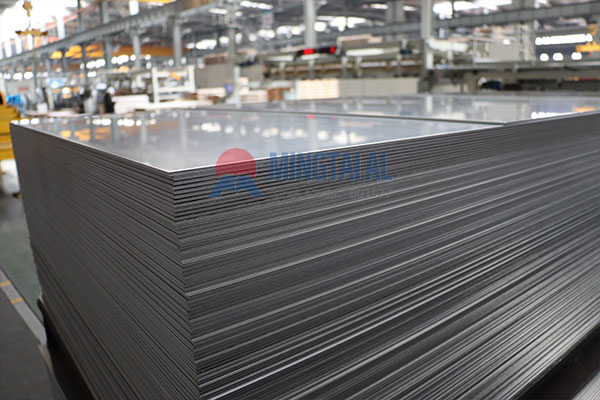
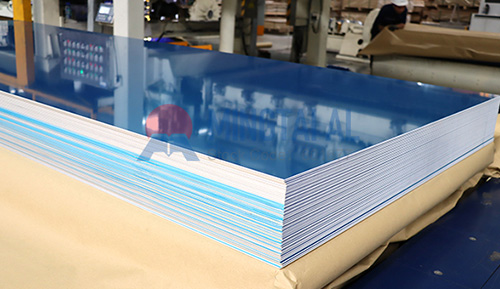
6101 Aluminum Sheet
In the aluminum alloy family, many people know that 1060 pure aluminum conducts electricity well but is too soft. They have also heard that 6061 offers high strength but only moderate conductivity.
The 6101 aluminum sheet sits right at the intersection of these two extremes. It achieves an electrical conductivity of around 55% IACS while maintaining solid mechanical strength. This dual capability makes it a go-to material for busbars, conductor rails, and other high-voltage conductive applications.
What Makes Up This Alloy?
6101 is a 6xxx-series alloy developed specifically for conductive structural components. It relies on magnesium-silicide precipitation for strengthening while strictly controlling harmful impurities to preserve conductivity.
Here is the typical chemical composition:
- Silicon (Si): 0.30%–0.70%
- Magnesium (Mg): 0.35%–0.80%
- Iron (Fe): ≤0.50%
- Copper (Cu): ≤0.10%
- Manganese (Mn): ≤0.03%
- Chromium (Cr): ≤0.03%
- Zinc (Zn): ≤0.10%
- Titanium (Ti): ≤0.03%
- Boron (B): ≤0.06%
- Aluminum: Balance
Silicon and magnesium are the core alloying elements. During heat treatment, they form Mg₂Si strengthening phases that raise tensile and yield strength.
Transition metals like copper, manganese, chromium, and titanium impede electron movement within the aluminum matrix, sharply reducing conductivity. That is why 6101 sets strict upper limits on these elements.
The trace boron addition is a key design feature of this grade. Boron combines with residual transition elements such as titanium, vanadium, and chromium to form stable compounds, eliminating their electron-scattering effect. This preserves conductivity as much as possible while strength is enhanced—a formulation detail that sets 6101 apart from ordinary 6xxx alloys.
Key Properties: Good Conductivity Plus Strength
High electrical conductivity — typically around 55% IACS, close to pure aluminum levels.
High strength — T6 tensile strength far exceeds that of pure aluminum.
Good thermal conductivity — approximately 200–220 W/(m·K), combining current-carrying capability with heat dissipation.
Corrosion resistance — a dense surface oxide film provides strong resistance to atmospheric corrosion.
Formability — can be extruded, stamped, and welded with flexible shaping options.
The greatest value of 6101 lies in finding the balance point between conducting electricity and bearing loads. Pure aluminum conducts well but deforms and loosens easily. 6061 is strong but conducts at only around 43% IACS. 6101 delivers both good conductivity and dependable strength.
Where 6101 Aluminum Sheet Is Used
6101 is chosen when a part must carry current and hold its shape. That combination opens the door to several demanding industries.
|
Industry |
Typical Parts |
Why 6101 Fits |
|
Power transmission & distribution |
Busbars for high- and low-voltage switchgear, conductor rails, substation connectors, grounding busbars |
Carries current continuously while resisting bolt-tightening stress that can crush softer aluminum |
|
New energy |
Conductive modules in storage converters, internal brackets for high-power chargers, busbar plates in battery cabinets |
Handles temperature rise control and structural reliability in long-duty equipment |
|
Rail transit |
Traction conductive components, electric locomotive conductive brackets |
Supports lightweight design with conductivity, vibration resistance, and deformation resistance |
|
Other industrial |
High-power heat dissipation and conduction assemblies, industrial power supply connection plates |
Combines electrical function with mechanical support in compact designs |
In short, if the part only conducts current, pure aluminum may be enough. If it also needs to stay tight and stable, 6101 is often the more practical choice.
6101 vs. 1060 Aluminum Sheet: How to Choose
The choice is not about one grade being “better.” It is about what the part has to do.
Choose 1060 when:
- Maximum conductivity is the top priority
- The part carries current but sees little or no mechanical load
- The design allows for extra support and does not rely on bolted joints staying tight
Choose 6101 when:
- The part must conduct electricity and bear mechanical load
- Bolted joints need to stay tight over time
- The application involves switchgear, busbars, or other current-carrying structures
- Resistance to deformation and vibration matters
A simple rule: 1060 is the purer conductor; 6101 is the better all-rounder. That is why high-voltage switchgear and busbar systems—where electricity and mechanical stress meet—commonly rely on 6101 aluminum sheet.
Pure aluminum conductors and structural aluminum alloys each have limitations. 6101 electrical-grade aluminum alloy fills the gap between them. Through precise magnesium-silicon ratio control and impurity management, it significantly boosts material strength while retaining good conductivity, solving the industry pain points of easy deformation and overheated joints in pure aluminum conductive parts. As new energy, energy storage, and rail transit industries grow rapidly, power equipment is upgrading toward higher power and higher reliability, and demand for 6101 aluminum sheet continues to rise.
FAQ
Q: What is 6101 mainly used for?
A: It is primarily used for busbars, conductor rails, and conductive structural parts.
Q: Is 6101 better than 1060 for busbars?
A: Yes, when the busbar needs to bear mechanical loads in addition to conducting current.
Q: What is the conductivity of 6101?
A: Typically around 55% IACS.
Q: Can 6101 be welded?
A: Yes, it has good weldability and formability.
Q: What temper is best for conductive applications?
A: T6 is commonly used for its combination of strength and conductivity.
Henan Mingtai produces 6101 electrical-grade aluminum sheet at scale, with full process control from ingot casting and rolling to heat treatment and finishing. The sheets offer tight dimensional tolerances, consistent batch-to-batch conductivity, and customizable cutting for power and new energy equipment manufacturers.