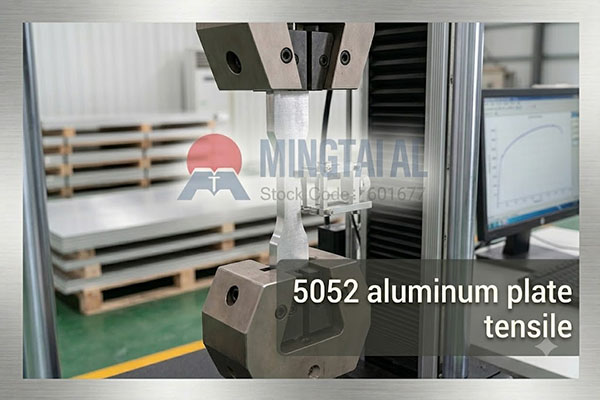
5052 aluminum plate tensile
Key Mechanical Properties of 5052-H32
5052 aluminum is alloyed primarily with magnesium (2.2%–2.8%) and a small amount of chromium (0.15%–0.35%). It is a work‑hardening alloy, meaning its strength comes from cold working rather than heat treatment.
For the most common temper, H32, typical mechanical properties are:
- Ultimate Tensile Strength: 228 MPa (33,000 psi)
- Yield Strength (0.2% offset): 193 MPa (28,000 psi)
- Elongation at Break: 12% (for 1.6 mm thick specimen)
- Brinell Hardness: 60
- Modulus of Elasticity: 70.3 GPa
- Density: 2.68 g/cm³
- Shear Strength: 138 MPa
- Fatigue Strength: ~117 MPa (at 500 million cycles)
These figures are industry‑standard values from the Aluminum Association and serve as a reliable benchmark for evaluating 5052‑H32 plate.
Mechanical Differences Among Tempers
5052 is available in several tempers, and the trade‑off between strength and formability is significant. Here is a quick comparison:
|
Temper |
Tensile Strength (MPa) |
Yield Strength (MPa) |
Elongation (%) |
Characteristics |
|
|
5052‑O (Annealed) |
~193 |
~90 |
~25 |
Best plasticity, ideal for deep drawing and complex forming |
|
|
5052‑H32 (¼ hard) |
~228 |
~193 |
~12 |
Best balance of strength and formability – most popular |
|
|
5052‑H34 (½ hard) |
~262 |
~214 |
~10 |
Higher strength, slightly less formable |
|
|
5052‑H38 (Full hard) |
≥270 |
— |
Lower |
Maximum strength, minimum ductility |
|
What does this mean for you?
- O‑temper gives you the highest elongation (~25%), making it the first choice for parts that require severe bending or deep drawing. However, its yield strength is only about 90 MPa, so it is not suitable for load‑bearing structures.
- H32 hits the sweet spot. With 228 MPa tensile and 12% elongation, it handles most sheet metal fabrication jobs—bending, stamping, welding—without cracking, while still offering good mechanical resistance.
- H34 pushes tensile strength up by roughly 30 MPa over H32, but elongation drops to around 10%. Choose H34 if your design demands higher strength and you only need moderate forming.
- H38 is the strongest (≥270 MPa) but has limited ductility. Use it only when strength is the top priority and post‑forming is minimal.
How Fabrication Affects Mechanical Performance
A common concern: *Will welding or bending change the strength of my 5052 plate?*
First, remember that 5052 cannot be strengthened by heat treatment—its properties are set by cold work. So any heating (like welding) will locally anneal the material, slightly reducing strength in the heat‑affected zone.
That said, 5052 welds very well. With MIG or TIG welding, the welded joint typically retains 90%–95% of the parent metal’s tensile strength. This makes it a reliable choice for welded assemblies.
For cold bending, follow these minimum inside bend radius guidelines (as a multiple of plate thickness):
- H32: ~1× thickness
- H34: ~1.5× thickness
Going below these values may cause surface cracking. Always test with your specific thickness before mass production.
Selecting the Right Temper Based on Strength Needs
Choosing the right temper is all about matching tensile properties to your application. Here is practical guidance:
Go with H32 when:
- You need a good mix of strength and formability
- Your parts involve bending, punching, or moderate stamping
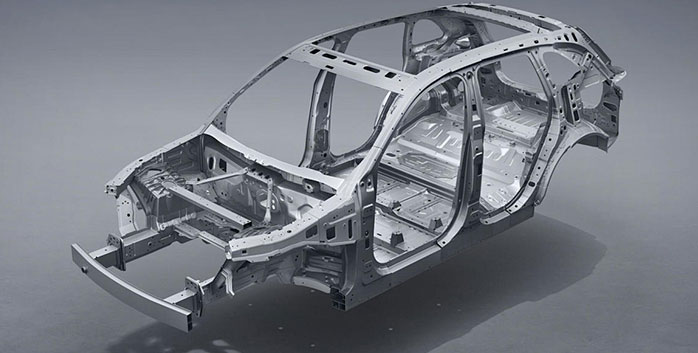
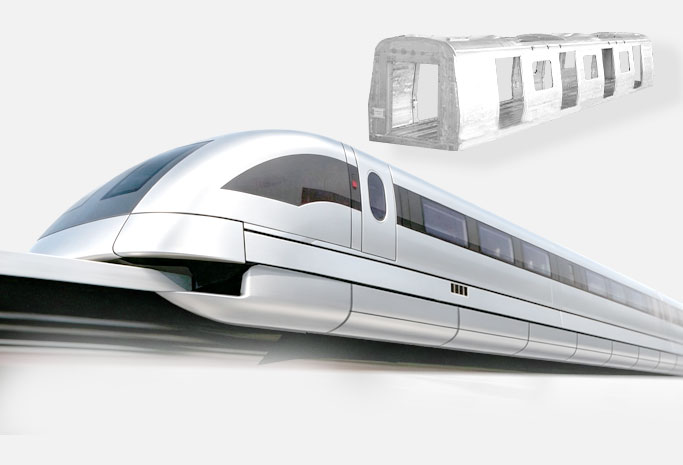
- Typical uses: automotive fuel tanks, engine shrouds, marine sheet components, aircraft structural parts
Choose O‑temper when:
- You require deep drawing or highly complex shapes
- The part will be heavily cold‑formed after delivery
- Post‑forming strength is less critical than workability
Consider H34 or H38 when:
- Your design demands higher tensile strength and stiffness
- Little or no secondary forming is needed
- Fatigue resistance is a key concern
Comparing 5052 with Other Common Aluminum Alloys
Seeing 5052 in context helps you decide whether it is the right fit for your project.
|
Alloy & Temper |
Tensile Strength (MPa) |
Key Features |
|
5052‑H32 |
~228 |
Balanced strength, excellent formability, corrosion resistance, and weldability |
|
5083‑H12 |
~330 |
Higher strength, marine‑grade, suited for severe structural service |
|
6061‑T6 |
~340 |
Heat‑treatable, much stronger but less formable than 5052
|
|
3003‑H14 |
145–195 |
Lower strength, better for light stamping and decorative work |
In short, 5052 occupies the middle ground—it offers moderate strength while excelling in formability and corrosion resistance. If your project involves extensive bending and welding, 5052 often outperforms 6061. If you need ultimate strength and can compromise on formability, look at 5083 or 6061‑T6.
Mingtai Aluminum supplies 5052 aluminum plate in H32, H34, and O‑tempers to match your specific tensile and formability requirements. Contact us for certified mechanical data and custom thickness options.
FAQ
Q1: What is the tensile strength of 5052‑H32 aluminum plate?
A: The typical ultimate tensile strength is 228 MPa (33,000 psi); it varies from ~193 MPa (O‑temper) to over 270 MPa (H38).
Q2: What is the difference between 5052‑H32 and 5052‑H34?
A: H34 has about 30 MPa higher tensile strength than H32, but its elongation is lower (~10% vs. ~12%), meaning reduced formability.
Q3: Can I heat‑treat 5052 to increase its strength?
A: No, 5052 is a non‑heat‑treatable alloy; strength is achieved through cold working, not thermal processing.
Q4: Which is stronger, 5052 or 6061?
A: 6061‑T6 is stronger (~340 MPa) than 5052‑H32 (~228 MPa), but 5052 offers much better formability and corrosion resistance.
Q5: What is the yield strength of 5052‑H32?
A: The typical yield strength (0.2% proof stress) is 193 MPa (28,000 psi).
Q6: What is the elongation of 5052‑H32?
A: For 1.6 mm thick material, it is approximately 12%.