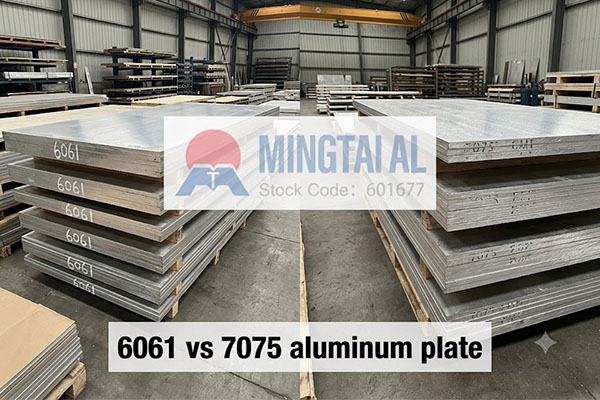
6061 vs 7075 aluminum plate
When comparing 6061 vs 7075 aluminum plate, engineers and procurement professionals often face a straightforward but critical choice. These two alloys look similar on the surface, but their performance profiles couldn't be more different—one is a versatile all-rounder, the other a high-strength specialist. Picking the wrong one can lead to either underperforming parts or unnecessary budget overruns. Let's break down the real-world differences across multiple dimensions.
Chemical Composition: Where the Difference Starts
The performance gap between these alloys comes down to their ingredient lists.
6061 belongs to the Al-Mg-Si family, with about 97.9% aluminum content. Its key additions are roughly 1% magnesium and 0.6% silicon, plus small amounts of copper and chromium. This recipe gives it a balanced set of properties—good strength, formability, and corrosion resistance.
7075, on the other hand, is an Al-Zn-Mg-Cu super-hard alloy, containing around 90% aluminum. It packs about 5.6% zinc, 2.5% magnesium, and 1.6% copper. The heavy dose of zinc and copper is what pushes 7075's strength far beyond typical aluminum alloys.
In short: 6061 is formulated for balance; 7075 is formulated for sheer strength.
Mechanical Properties: How Big Is the Strength Gap?
This is the most fundamental difference between the two.
In the T6 heat-treated condition, 6061 offers a tensile strength of roughly 290–310 MPa and a yield strength around 240–276 MPa. That level is more than adequate for most general structural applications.
By contrast, 7075-T6 delivers tensile strength above 520 MPa and yield strength around 480–503 MPa. In other words, 7075 is nearly twice as strong as 6061. The hardness gap is equally clear—7075 clocks in at about 150 HB, while 6061 sits around 95 HB.
But here's the catch: "stronger" doesn't automatically mean "better." If your part doesn't see extreme stresses, paying a premium for strength you'll never use is simply wasteful.
Machinability: Which One Cuts Better?
On this front, 6061 has a clear edge.
Its lower hardness means smoother cutting, less chip adhesion, and reduced tool wear. For high-volume CNC machining, 6061 is the more cost-efficient choice.
7075 can certainly be machined, but its higher hardness accelerates tool wear and demands more careful process control. Both machining time and tooling costs tend to rise. If your project involves extensive machining, 6061 will save you time and money.
Weldability and Corrosion Resistance
Weldability is one area where the two alloys diverge dramatically. 6061 welds beautifully with TIG, MIG, and other common processes. 7075, however, is notoriously difficult to weld—it's prone to hot cracking, and the heat-affected zone suffers a significant strength drop. Unless you're using specialized methods like friction stir welding, welding 7075 is generally not recommended.
Corrosion resistance also favors 6061. It performs well in humid, outdoor, and even marine environments. 7075 is more susceptible, especially to stress corrosion cracking. If your part will live in a corrosive setting, 6061 is the safer bet.
Typical Applications: Each Finds Its Niche
6061 is commonly used for:
- General structural components, machine parts, and frames
- Automotive parts (door frames, hoods, etc.)
- Marine construction and truck bodies
- Any assembly that requires welding
7075 is typically reserved for:
- Aerospace structures (wings, landing gear, etc.)
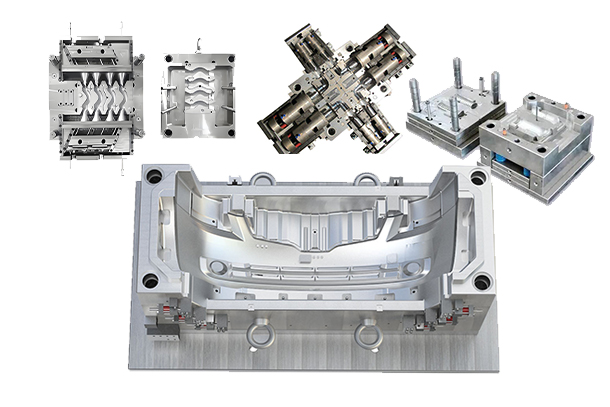
- High-stress molds and precision tooling
- Premium sporting goods (high-end bicycles, golf clubs)
- Defense and military components
A simple rule of thumb: if your part isn't going into an aircraft, 6061 will likely do the job.
Cost Comparison
7075's more complex chemistry and stricter production requirements make it significantly more expensive. For standard gauges, 7075 typically costs roughly double that of 6061 per kilogram. For large-volume purchases, that difference adds up quickly and can dominate your material budget.
How to Choose? A Quick Decision Table
|
Consideration |
Choose 6061 |
Choose 7075 |
|
Strength needed |
Moderate |
Extreme / high-stress |
|
Welding required |
Yes |
No (or very limited) |
|
Machining volume |
High-volume CNC |
Low-volume / precision |
|
Environment |
Outdoor, humid, marine |
Dry, controlled, high-stress |
|
Budget |
Cost-sensitive |
Flexible |
|
Industry |
General industrial, automotive, marine |
Aerospace, defense, high-end tooling |
Making the Right Choice
Ultimately, when you're weighing 6061 vs 7075 aluminum plate, the decision comes down to this: 6061 is the practical, reliable workhorse—it welds well, machines easily, resists corrosion, and won't break the bank. It fits the vast majority of industrial applications. 7075 is the performance specialist—it delivers top-tier strength, but you'll pay for it in material cost, machining difficulty, and welding limitations. Choose the alloy that matches your part's real requirements, not just its maximum potential.
Henan Mingtai Aluminum supplies a full range of 6061 and 7075 aluminum plates in various specifications. Contact us for selection advice and competitive quotes.*
FAQ
Q1: How much stronger is 7075 than 6061?
A: 7075's tensile strength is nearly 1.7 times that of 6061 in T6 temper.
Q2: Can 7075 be welded?
A: Welding 7075 is not advised due to hot cracking and significant strength loss.
Q3: Which alloy is easier to machine?
A: 6061 machines easier with lower tool wear and faster cutting speeds.
Q4: Why is 7075 so much more expensive?
A: It costs about twice as much because of costly alloying elements and stricter processing.
Q5: How do I decide between the two?
A: Choose 6061 for weldability and cost efficiency, or 7075 for extreme strength in aerospace/defense.
Q6: Which has better corrosion resistance?
A: 6061 outperforms 7075, especially in humid or marine environments.