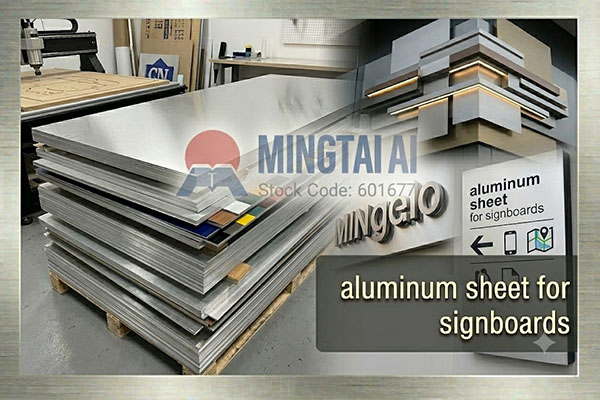
aluminum sheet for signboards
Alloy Selection: Three Series, Three Purposes
For signboards, the most common aluminum alloys fall into three series: 1xxx, 3xxx, and 5xxx.
- 1xxx (1060, 1100) – over 99.0% pure aluminum. Soft, easy to form, and low‑cost, but also the weakest. Best for indoor nameplates and decorative signs that bear little load.
- 3xxx (3003) – aluminum‑manganese alloy. Stronger than pure aluminum and offers good corrosion resistance. A cost‑effective workhorse for both indoor and outdoor general use. If your budget is tight and the environment isn't harsh, 3003 is a safe starting point.
- 5xxx (5052, 5754) – aluminum‑magnesium alloy. Higher strength and superior corrosion resistance. 5052 is especially known for withstanding marine and industrial atmospheres. Ideal for large outdoor billboards, traffic signs, and coastal or polluted areas. (In fact, many U.S. traffic signs use 5052 to survive hurricane‑force winds.)
Quick rule: indoor small signs → 1xxx; general outdoor → 3xxx; harsh conditions or large projects → 5xxx.
Thickness: Not Thicker Always, but “Just Right”
Wrong thickness causes trouble too—too thin bends under wind, too thick wastes money and adds mounting difficulty.
Signboard aluminum typically ranges from 0.5 mm to 3 mm.
- 0.5–1.0 mm – indoor signs, lightweight applications, low cost.
- 1.0–1.5 mm – transition zone; small outdoor signs can use this.
- 1.5–3.0 mm – the main outdoor range. For smaller traffic signs, 1.5–2.0 mm; medium‑sized, 2.0–2.5 mm; large ones, 2.5–3.0 mm. Some regulated applications (like highway signs) have specific thickness mandates.
A simple rule of thumb: outdoor needs thicker, indoor thinner; windy areas need thicker, calm areas thinner; large sizes need thicker, small sizes thinner.
Weather Resistance: The Lifeline of Outdoor Signs
Signs aren’t meant to be replaced every two years. Sun, rain, wind—can the material hold up?
Aluminum’s natural advantage: it protects itself. A dense oxide layer forms on the surface, giving excellent corrosion resistance. While steel signs may need maintenance every 3–5 years, quality aluminum signs can last far longer even in coastal or industrial zones.
But not all alloys perform equally.
- 5052 is a classic marine‑grade alloy. Its magnesium‑rich oxide film resists rust in humid, salty, and many chemical environments. For outdoor signs exposed to rain and wind, 5052 preserves both appearance and structural integrity. Its high strength and fatigue resistance also prevent deformation from wind pressure.
- 3003 is decent in corrosion resistance, but not as robust as 5xxx. If your site is near the coast, in a high‑humidity area, or subject to wide temperature swings, prioritise 5xxx.
Also, the temper matters (e.g., H14, H24, H38). For instance, 5052 H38 is a very hard state that keeps surfaces smooth and resists bending even under high wind. Always ask your supplier about the specific temper.
Purchasing Pitfalls: Don’t Let “Cheap” Turn Into “Expensive”
Two coils with the same alloy number can behave very differently in use. Watch these key points:
- Thickness accuracy – Some suppliers sell “nominal” thickness but deliver “under‑thickness” material (e.g., labelled 1.2 mm but actually 1.1 mm). Always confirm whether the quoted thickness is “full” or “tolerance‑based,” and put it in writing. A simple calliper check on arrival is wise.
- Formability – Good aluminum bends and cuts cleanly; poor material cracks at the bend line and fails soon after.
- Alloy consistency – Are every batch’s composition, thickness, and temper stable? Some small mills use recycled scrap, resulting in brittle sheets that break easily. Insist that the supplier state the exact alloy grade on the delivery note or contract.
- Cross‑section inspection – Premium sheets show a uniform, bright edge; inferior ones may appear dull and rough.
Application Quick Reference
|
Application |
Recommended Alloy |
Recommended Thickness |
Key Concern |
|
Indoor directional signs |
1060 / 3003 |
0.5–1.0 mm |
Formability & appearance |
|
Storefront fascia signs |
3003 |
1.0–1.5 mm |
Weather resistance & cost |
|
Outdoor billboards |
5052 |
1.5–2.5 mm |
Wind load & corrosion |
|
Traffic signs |
5052 / 5754 |
1.5–3.0 mm |
High strength & long life |
|
Harsh‑environment signs |
5052 / 5754 |
2.0–3.0 mm |
Maximum corrosion protection |
Final Takeaway
Selecting the right signboard material boils down to three things: choose alloy by environment, choose thickness by need, and choose a supplier with consistent quality. Miss any one, and you risk failure.
Mingtai Aluminum offers a dependable range of aluminum sheet for signboards with tight thickness tolerances and stable alloy properties—backed by decades of production expertise.
FAQ
Q1: Which aluminum alloy is best for outdoor signs?
A: 5052 and 5754 are top picks due to their superior corrosion resistance and strength.
Q2: How thick should an outdoor aluminum sign be?
A: Most outdoor applications need 1.5–3.0 mm; larger signs and high‑wind areas require thicker sheets.
Q3: Does aluminum signboard rust?
A: No—aluminium naturally forms a protective oxide layer that prevents rust, outlasting steel outdoors.
Q4: How long can an outdoor aluminum sign last?
A: With proper alloy and thickness, it can serve reliably for many years even in coastal or industrial settings.