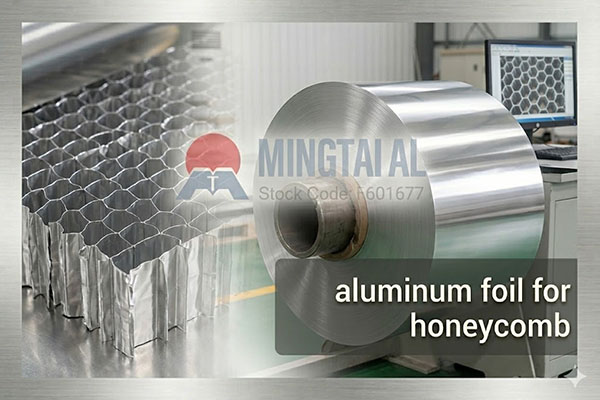
aluminum foil for honeycomb
Introduction
Aluminum honeycomb core—a structure made by bonding, stacking, and expanding multiple layers of aluminum foil into a regular hexagonal cell pattern—is increasingly replacing traditional solid panels. It appears everywhere: from building facades and high-speed train interiors to furniture manufacturing and aerospace. The performance of a honeycomb core largely depends on one fundamental question: which aluminum foil for honeycomb are you using?
Among the many aluminum alloy grades, 3003 has steadily become the mainstream choice for honeycomb core production. Why?
3003 vs. 1100: A Real Strength Gap
1100 is commercially pure aluminum—good formability, but low strength. When used for honeycomb core, its node strength is insufficient, leading to spring-back after stamping and easy collapse of the honeycomb cells.
3003 belongs to the Al-Mn (aluminum-manganese) series. The addition of manganese significantly boosts its strength over 1100 foil. Honeycomb cores made from 3003-H18 foil maintain their shape well, with flat cross-sections, burr-free edges, and smooth panel flatness after bonding. In plain terms: 1100 may soften over time; 3003 holds its structure reliably.
3003 vs. 5052: When Over-Engineering Wastes Money
5052 is an Al-Mg alloy with superior strength and corrosion resistance—ideal for aerospace or marine environments where material demands are extreme.
But it comes at a significantly higher cost. For the vast majority of applications—building facades, interior decoration, standard transport interiors—5052 delivers more performance than actually needed. 3003 strikes a more practical balance between strength, formability, corrosion resistance, and cost. Industry guidelines often recommend that 3003 and 5052 are both suitable for high-strength or durability requirements, while 1100 should be used with caution.
Why H18 Temper Matters
Choosing the right alloy is only the first step—the temper is equally critical.
The mainstream temper for 3003 honeycomb foil is H18 (full hard), achieved through cold working without annealing. This gives the foil high rigidity and strength.
Common thicknesses range from 0.02mm to 0.08mm, with 0.04mm–0.06mm being the most widely used. Thinner foil means lighter core, but too thin compromises strength—3003-H18 offers a reliable range to balance both.
Beyond Alloy and Thickness: The Real Quality Differentiators
Many buyers focus only on alloy grade and thickness, but the true determinants of finished core quality are often these hidden indicators:
- Flatness (shape control): Wave and warp must be tightly controlled. Uneven foil causes uneven adhesive distribution, leading directly to delamination. Reputable suppliers use online shape-control systems and secondary tension-leveling to ensure flatness.
- Surface cleanliness (residual oil): Rolling oil left on the foil hinders adhesive wetting, significantly reducing bond strength. Industry standards recommend residual oil ≤20 mg/m²; premium products can achieve even lower levels. Clean foil ensures durable adhesive bonds and longer service life.
- Thickness tolerance: Excessive variation leads to uneven cell heights, resulting in wavy finished panels. Tight tolerance (typically ±5% or better) is essential for flat, consistent panels.
These three factors separate foil that is “usable” from foil that is truly “reliable.”
Where 3003 Honeycomb Core Is Used
3003-H18 honeycomb foil serves a broad range of industries:
- Architectural cladding: Curtain walls, interior wall panels, ceilings, roofing—lightweight yet strong, reducing building loads.
- Transportation: High-speed rail, metro, and ship interior panels, flooring, and partitions—significantly reducing vehicle weight.
- Furniture manufacturing: Aluminum furniture cabinets and door panels—moisture-proof, insect-proof, fire-resistant, and offering excellent flexural strength.
- Other industrial uses: Electronic enclosures, precision instruments, air purification equipment, and more.
The honeycomb structure is mostly air, giving it extremely low density, while the hexagonal cells act like countless tiny I-beams to efficiently distribute pressure—achieving the core value of “lightweight and strong.”
The Verdict
So, why is 3003 the superior choice for honeycomb core? Because it does not claim to be the “most expensive” or the “softest”—it is simply the most suitable. With moderate strength, excellent formability, reliable corrosion resistance, reasonable cost, and the rigidity of H18 temper, 3003 has proven itself time and again in this demanding application. Selecting the right aluminum foil for honeycomb is the first and most crucial step toward quality finished cores.
As a professional aluminum foil manufacturer, Mingtai Aluminum supplies 3003-H18 honeycomb foil known for its flatness, thorough degreasing, and consistent strength—trusted by many honeycomb core producers worldwide.
FAQ
Q1: Why choose 3003 over 1100 for honeycomb core?
A: 3003 offers much higher strength and better node strength, preventing core collapse and spring-back during stamping.
Q2: How do I decide between 3003 and 5052?
A: Choose 3003 for most architectural and transport interiors due to its cost-performance; choose 5052 only for extreme marine or aerospace conditions.
Q3: What thickness and temper are recommended for honeycomb foil?
A: 3003-H18 (full hard) with thickness between 0.04mm and 0.06mm is the most common and reliable specification.
Q4: Apart from alloy and thickness, what should I check when buying foil?
A: Pay close attention to flatness, residual oil level, and thickness tolerance—they directly affect bonding quality and panel flatness.
Q5: Can 3003 honeycomb core be used outdoors?
A: Yes—3003 has good corrosion resistance and is widely used in building facades and other exterior applications.