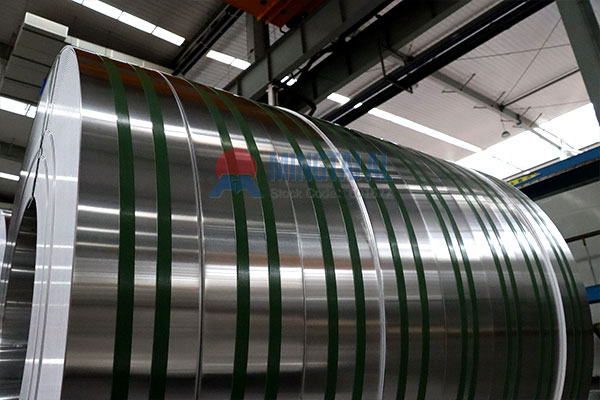
aluminum strip for transformer shielding
Electrical grade aluminum strip for transformer shielding is a key material used in dry‑type and oil‑immersed transformers. It sits between windings to block electrostatic and electromagnetic interference. The quality of this strip directly influences transformer losses, temperature rise, and service life. This article walks through alloy grades, critical parameters, and quality control points to give a clear view of what really matters.
Common Alloy Grades and Their Conductivity
The main alloys for this application are 1050, 1060, 1070, and 1350. The differences come down to purity and conductivity:
|
Alloy |
Minimum Al Purity |
Typical Conductivity (O‑temper) |
Typical Applications |
|
1050 |
≥99.50% |
≥60.0% IACS |
General low‑voltage, small transformers |
|
1060 |
≥99.60% |
≥61.5% IACS |
Most widely used – best cost‑performance balance |
|
1070 |
≥99.70% |
≥62.7% IACS |
High‑efficiency and renewable‑energy transformers |
|
1350 |
≥99.50% |
≥62.0% IACS |
Electrical‑grade specialty with strict impurity control |
Conductivity matters because every percentage point reduces measurable losses over years of operation. For projects demanding maximum efficiency, 1070 and 1350 are top choices. For most standard specifications, 1060 already meets all technical requirements reliably.
Critical Quality Parameters That Affect Shielding Performance
Performance differences often hide in a few core parameters.
Electrical Resistivity
Industry standards set a maximum resistivity of 0.02825 Ω·mm²/m at 20°C. Lower resistivity means less heat generation during current flow – a direct contributor to transformer efficiency.
Dimensional Tolerances (Thickness and Width)
Precise dimensions ensure consistent electrical performance across the winding. Typical thickness ranges from 0.2 mm to 3.0 mm, and width from 30 mm up to 1600 mm. Tolerances tighten as thickness decreases:
|
Thickness Range |
Thickness Tolerance |
|
0.2 – 0.4 mm |
±0.01 mm |
|
0.4 – 0.8 mm |
±0.015 mm |
|
0.9 – 1.1 mm |
±0.02 mm |
|
1.2 – 1.6 mm |
±0.025 mm |
|
1.8 – 2.5 mm |
±0.03 mm |
Tighter tolerances give better fitting of the shielding layer against the winding, which improves electrical uniformity.
Edge Quality and Burr Control
This is often the most overlooked yet most critical factor. Burrs on the strip edge can puncture insulation during winding, leading to partial discharge risks – a common cause of premature transformer failure.
Standard burr height limits are:
- For thickness ≤ 0.20 mm: burr ≤ 0.03 mm
- For thickness > 0.20 mm: burr ≤ 0.05 mm
Higher‑quality products offer round‑edge treatment, which eliminates burr‑related damage to insulating materials from the start. The strip is supplied in its finished state, ready for winding without any additional surface treatment or further processing.
Applicable Standards and Quality Assurance
Reliable transformer shielding strip should comply with recognized standards. Common ones include:
- GB/T 3880 – General Chinese standard for aluminum sheet and strip
- YS/T 713‑2009 – Chinese standard specifically for dry‑type transformer aluminum strip and foil
- ASTM B209 – U.S. standard for aluminum sheet and strip
- JIS H4000 – Japanese standard for aluminum sheet and strip
When sourcing, always request material certificates and complete test reports – these are the basic proof of compliance.
Selection Checklist
Based on everything above, here is a practical checklist for evaluating shielding strip:
- Confirm the alloy grade matches the design requirement (1050, 1060, 1070, or 1350)
- Verify conductivity meets the specified minimum for that grade
- Check thickness tolerance against the required winding process
- Check width tolerance for proper fit
- Measure burr height against the limits given above
- Inspect surface for scratches, wrinkles, oil stains, or other defects
- Ensure the product complies with one of the recognised standards (GB/T, YS/T, ASTM, or JIS)
- Require full material certificates and test reports from the supplier
The difference between average and high‑quality shielding strip ultimately shows up in long‑term transformer reliability and energy consumption. Every detail – from alloy selection to burr control – deserves attention. For a consistent supply of electrical grade aluminum strip for transformer shielding, Mingtai Aluminum offers a full range of 1050, 1060, 1070, and 1350 alloys with tight tolerances and stable quality.
FAQ
Q1: What is the most commonly used alloy for transformer shielding?
A: 1060 is the most popular grade because it combines good conductivity (≥61.5% IACS), workability, and cost‑effectiveness.
Q2: What is the minimum conductivity required for this application?
A: For 1050 it is ≥60% IACS; higher grades like 1070 reach ≥62.7% IACS.
Q3: Why is burr control so important for shielding strip?
A: Burrs can pierce insulation during winding, creating partial discharge paths that may lead to transformer failure.
Q4: What thickness range is normally available?
A: Typical thicknesses run from 0.2 mm to 3.0 mm, with tolerances as tight as ±0.01 mm for thinner gauges.
Q5: Which standard covers aluminum strip for dry‑type transformers in China?
A: YS/T 713‑2009 is the dedicated Chinese standard for dry‑type transformer aluminum strip and foil.