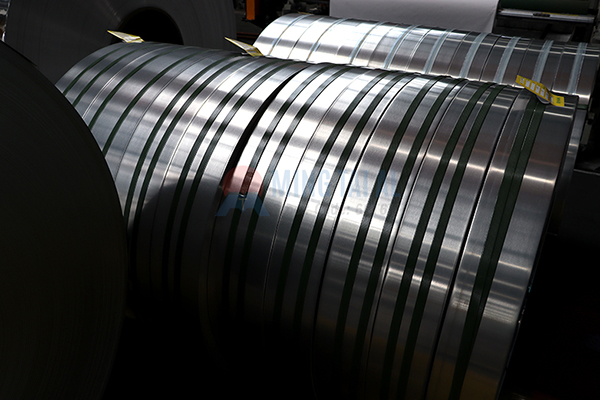
aluminum strip for cable armor
For cable manufacturers, the choice of armoring material directly affects product performance, production costs, and application safety. Among the available options, aluminum strip for cable armor stands out for its unique combination of lightweight properties and electrical conductivity. This article focuses on two core aspects—flexibility and shielding—to help you understand the key selection criteria for aluminum strip in cable armoring.
Why Use Aluminum Strip for Cable Armor?
The armoring layer serves two essential roles: protecting against mechanical damage and managing electromagnetic interference in complex environments. The material you choose determines mechanical strength, bending performance, shielding effectiveness, and service life. Aluminum strip is preferred for three main reasons:
- It meets two seemingly conflicting demands—flexible wrapping and efficient shielding—both of which aluminum handles exceptionally well.
- Its non‑magnetic nature eliminates the eddy‑current losses that steel tape causes in single‑core AC cables—a critical advantage steel cannot offer.
- It provides a balanced combination of weight, corrosion resistance, and formability, making it suitable for a wide range of cable designs.
Flexibility: Engineering Considerations from Material Selection to Wrapping
Cable armoring typically uses a helical wrapping process, where the strip must bend continuously at high speed, conform tightly to the cable core, and remain intact without cracking. This “rigid‑yet‑flexible” behavior depends on two key factors.
Choice of Alloy Grade
Different alloys give the strip distinct properties:
- 1060 – high purity, excellent conductivity, and softness, ideal for applications requiring superior bending performance.
- 3003 – manganese‑added for increased strength, suitable for armoring layers that need moderate mechanical support.
- 5052 – aluminum‑magnesium alloy with higher strength and better corrosion resistance, perfect for marine or industrial environments.
The Critical Role of Temper
Even with the same alloy, temper makes a significant difference:
- O‑temper (fully annealed) – offers the best ductility, ideal for tight bending radii and compact wrapping.
- H14/H24 (half‑hard) – balances strength and formability, fitting most general armoring needs.
- H18 (full‑hard) – delivers the highest strength for applications that demand superior rigidity.
Selection tip: If your cable requires frequent bending or installation through narrow conduits, prioritize O‑temper or H24. If compressive strength is more important, H14 or H18 may be better choices.
Shielding Performance: How Aluminum Strip Protects Signal Integrity
In power, communication, and control cables, electromagnetic interference is a major concern for system stability. Aluminum strip offers several shielding advantages:
- Forms a continuous conductive barrier – the armoring layer itself acts as a metallic shield that effectively blocks external interference.
- Excels at high‑frequency shielding – thanks to aluminum’s excellent electrical conductivity, it performs reliably in environments with high‑frequency EMI.
- Provides a stable grounding path – a critical function for safety‑critical industrial applications.
- Offers much higher conductivity than steel – the end‑to‑end conductivity of aluminum strip is significantly better, meaning more stable shielding effectiveness, which is why communication and control cables often prefer aluminum.
Aluminum Strip vs. Steel Tape: Key Differences at a Glance
|
Aspect |
Aluminum Armor |
Steel Armor |
|
Weight |
About one‑third of steel, greatly reducing total cable weight |
Heavy, increasing installation difficulty |
|
Magnetic properties |
Non‑magnetic, suitable for single‑core AC cables |
Highly magnetic, causes eddy‑current losses in single‑core AC applications |
|
Corrosion resistance |
Natural oxide layer, resistant to moisture and chemicals |
Requires additional zinc coating or other treatments |
|
Bending flexibility |
Excellent, allows smaller bending radii |
Stiffer, with limited bending performance |
|
Shielding mechanism |
Relies on high electrical conductivity for EMI shielding |
Relies on magnetic permeability for magnetic shielding |
Important note: For single‑core AC cables, steel’s magnetic properties lead to eddy‑current heating, wasting energy and creating safety risks. Aluminum’s non‑magnetic advantage is irreplaceable in these cases.
Which Cable Types Benefit from Aluminum Armor?
Aluminum armor is widely used across several cable segments:
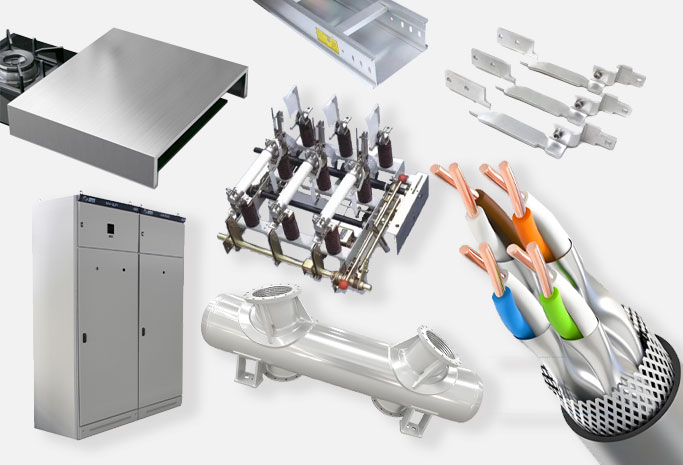
- Power cables – mechanical protection and shielding for urban distribution networks and underground transmission lines.
- Communication cables and fiber optic cables – EMI shielding and structural support for backbone communication lines.
- Marine cables – corrosion‑resistant armoring for submarine composite power‑and‑fiber cables.
- Mining and industrial cables – impact and abrasion resistance for heavy‑duty trailing cables.
- Metal‑clad (MC) cables for buildings – lightweight armoring solutions.
Different applications demand different thicknesses, widths, alloys, and tempers. For example, marine projects prioritize 5052 for its seawater corrosion resistance, while communication cables value the high conductivity of pure aluminum.
Practical Tips for Sourcing and Specification
When sourcing aluminum strip for your armoring line, consider these aspects:
- Alloy and temper – do they match your cable design standards and production process requirements?
- Dimensional tolerances – are thickness and width accurate enough for high‑speed wrapping equipment stability?
- Edge quality – burrs, wavy edges, or buckling directly affect wrapping coverage and yield rate.
- Delivery condition – ensure the product is supplied as bare cold‑rolled coils, with a smooth, clean, and flat surface, ready for continuous wrapping without any additional coating or lamination.
Our aluminum strip for cable armor is available in multiple alloys (1060, 1100, 3003, 5052) and tempers (O, H14, H24, H18), and we can slit to your required dimensions. Mingtai Aluminum welcomes your inquiries for more technical details.
FAQ
Q: Which alloy is better for communication cables?
A: Pure aluminum 1060 is best for communication cables due to its high conductivity and flexibility.
Q: How does O‑temper differ from H24 in wrapping?
A: O‑temper is softer and wraps more easily, while H24 offers a balanced mix of strength and formability.
Q: Can aluminum‑armored cables be buried directly?
A: Yes, with a proper outer sheath, they meet all direct‑burial requirements.
Q: What is the main role of aluminum armor compared to copper tape?
A: Aluminum armor provides mechanical protection and structural support, while copper tape is purely for precision shielding.
Q: How is the correct strip width determined?
A: The width is calculated from cable diameter and overlap ratio by your process engineer.