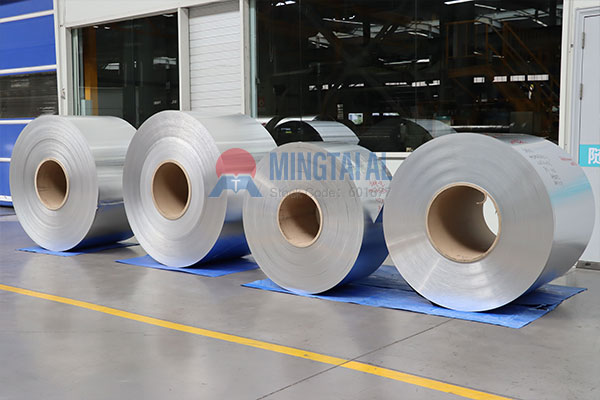
aluminum strip coil width tolerance
In the procurement specifications for aluminum coil, width tolerance is often just a line of numbers, overshadowed by alloy grade or thickness. But for shops running stamping lines daily, the aluminum strip coil width tolerance is a critical factor that determines whether your dies last three months or three years.
How Width Deviation Harms Your Dies
The importance of width tolerance comes down to one fact: stamping dies have very limited room for error in material width.
- Excessive width – the direct cause of die jamming. In progressive dies, the strip must pass through guide plates or feed channels. When the actual width exceeds the nominal value, the strip cannot move smoothly. At high speed, even a single jam can damage guide plates, punches, or the entire die core – often irreversibly.
- Insufficient width – loss of positioning accuracy. A narrow strip fails to locate precisely within the die. In multi‑step progressive tools, positioning errors accumulate step by step, leading to out‑of‑tolerance parts. Punches then experience off‑centre forces, which can bend or break delicate tooling components.
- Width fluctuations – the hidden wear accelerator. Even if the width stays within extreme limits, variation within a coil or between batches is equally dangerous. Changing dimensions cause inconsistent loading on the die surfaces, accelerating fatigue wear, dulling cutting edges faster, and increasing burr formation – all of which shorten die life significantly.
Industry Standards and Precision Grades
Width tolerance is primarily determined by the slitting equipment used. Current slitting technology can achieve different grades:
- General industrial use – tolerance around ±0.2 mm
- Precision stamping applications – up to ±0.05 mm or tighter
International standards provide reference frameworks: ASTM B209 (US) for aluminium sheet and coil; EN 485 series (Europe) for dimensional tolerances; and ISO 6361 for wrought aluminium and aluminium alloy strip. When specifying tolerance, always match the grade to your actual die design and stamping conditions – not just to a generic number.
Why Negative Tolerance Protects Your Dies
In aluminium coil slitting, an industry‑accepted practice is to maintain width on the “minus” side – that is, slightly narrower than the nominal size.
The logic is simple: better too narrow than too wide. A slightly narrower strip has enough clearance to pass through die guides without binding, while a wider strip risks jamming the die instantly. In high‑speed progressive stamping, one jam can scrap an expensive die set.
That said, excessive negative tolerance is also undesirable – too narrow hurts positioning. The key is a stable, controlled tolerance range that matches your tooling design.
Four Practical Reminders When Ordering Aluminium Coil
1. Don’t chase the tightest tolerance blindly. Insisting on ±0.02 mm often adds cost and lead time without real benefit. A stable ±0.05 mm to ±0.1 mm is sufficient for most stamping operations, as long as it is consistent and compatible with your dies.
2. Prioritise uniformity within the coil. Some suppliers guarantee only the head and tail, but the middle section may fluctuate. Uniformity matters more than the absolute number – variation means changing load conditions throughout production.
3. Share your die parameters proactively. The right tolerance depends on your actual guide slot width and stamping speed. Provide these details to your supplier; they can then recommend the most suitable range rather than guessing.
4. Don’t overlook edge quality. Slitting leaves burrs or edge waves that do not affect nominal width but do affect how the strip feeds through the die. Rough edges increase friction against guide plates, accelerating their wear. Always ask for edge condition indicators alongside width tolerance.
The Real Payoff: Longer Die Life
The aluminum strip coil width tolerance is never a set of isolated numbers. It directly determines whether your strip feeds smoothly, positions accurately at every step, and maintains stable force conditions across millions of cycles. Choosing a supplier who delivers consistent, precise width tolerance is essentially an investment in die life and production uptime.
Henan Mingtai Al offers a full range of aluminium coil products with tightly controlled width tolerance – helping you achieve longer die service life and more stable stamping operations.
FAQ
Q: What is the typical width tolerance for aluminium coil?
A: General purpose: ±0.2 mm; precision stamping: ±0.05 mm or better.
Q: Why is width tolerance often specified as negative?
A: A slightly narrower strip avoids jamming dies, while a wider one can cause immediate die damage.
Q: What happens if the width is too large?
A: The strip cannot enter the guide channels, leading to jamming and potential die breakage.
Q: What happens if the width is too small?
A: Poor positioning causes offset stamping, which may damage punches and produce out‑of‑spec parts.
Q: How do I choose the right tolerance for my needs?
A: Base it on your die guide design, stamping speed, and volume – then discuss with your supplier.
Q: Which matters more – width tolerance or edge quality?
A: Both are equally important; poor edges increase friction and wear even if the width is within tolerance.