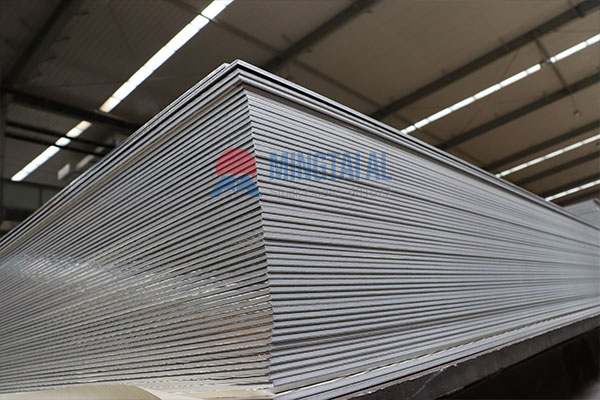
aluminum sheet for kitchen cabinet
Why Aluminum Works So Well in Kitchen Cabinets
Kitchens are tough on materials. Steam, grease, vinegar, and detergents attack surfaces daily, while temperatures swing from hot to cold in minutes. Wood warps and swells under humidity; stainless steel can pit when exposed to certain cleaners. Aluminum sheet for kitchen cabinet, however, handles these conditions with ease—thanks to its own natural properties.
The Self‑Made Shield: How Aluminum Resists Corrosion
The secret isn’t a coating or a special treatment—it’s the metal itself.
When exposed to air, aluminum instantly forms a thin oxide film (just a few nanometres thick) that is extremely dense and stable. This invisible layer acts like a built‑in armour:
- It blocks moisture, weak acids, and corrosive compounds found in cooking fumes.
- If scratched, the exposed fresh aluminium immediately re‑oxidises, healing the shield automatically.
This protection is inherent to the material. Any anodising or painting done later is mainly for appearance or texture—not for corrosion resistance.
Four Common Alloys – Each with a Different Strength
Not all aluminium grades perform the same in a kitchen. Here is how the most popular ones compare:
1100 (pure aluminium)
Its oxide film is very pure and stable in mild acidic/alkaline environments. Ideal for decorative interior panels or light‑duty trims.
3003 (aluminium‑manganese)
Manganese adds excellent rust‑proof characteristics—often called “anti‑rust aluminium.” A versatile choice for cabinet frames, back panels, and shelves, balancing cost and performance.
5052 (aluminium‑magnesium)
Outstanding resistance to salt spray and moisture, making it the top pick for coastal areas or high‑humidity kitchens. When maximum corrosion protection is needed, 5052 is the answer.
6061 (aluminium‑magnesium‑silicon)
Good corrosion resistance with moderate strength. Commonly used for load‑bearing structural components inside cabinets.
> Quick guide: Choose 5052 for the toughest environments, 3003 for general kitchens, and 1100 for dry decorative zones.
How Aluminum Stacks Up Against Wood and Stainless Steel
VS. Wood – a clear win
Wood is porous—it absorbs water, expands, cracks, and can develop mould. Even with edge sealing, once that seal breaks, moisture gets in. Aluminium is non‑porous; it does not absorb water. Spills and grease wipe off easily, and the material stays dimensionally stable for decades.
VS. Stainless steel – aluminium holds its own
Stainless contains iron and can suffer pitting corrosion in chlorine‑rich environments (e.g., bleach or salt). Aluminium’s oxide film is more stable against the weak acids and alkalis commonly found in kitchens. Plus, aluminium weighs about one‑third as much as steel, which reduces the load on hinges and installation fittings.
Performance in Real Kitchen Scenarios
Around the sink
Splashes and condensation are constant. Aluminium does not swell, rot, or develop mildew—even with prolonged exposure to moisture.
Near the cooktop
Fumes from frying contain oils and organic acids that can attack ordinary surfaces over time. The oxide layer on aluminium resists these mild acids well; regular wiping with a neutral cleaner keeps it clean without harming the metal.
Contact with cleaning agents
Dish soaps and degreasers are typically mild alkaline or neutral. Aluminium shows good chemical stability against these products, so routine cleaning poses no risk.
Temperature changes
Cooking creates rapid heating and cooling cycles. Aluminium handles wide temperature swings without structural damage—just remember to allow a small expansion gap during installation.
Three Key Factors When Choosing Aluminium Sheets
- Alloy: Coastal/high‑humidity → 5052; general kitchens → 3003; dry decorative areas → 1100.
- Temper: O‑temper (softest, best for bending) vs. H‑temper (higher strength). For cabinet doors that require folding, choose O‑temper or H1x.
- Thickness: Doors typically 0.8–1.5 mm; shelves and back panels 0.6–1.0 mm; load‑bearing parts can be thicker.
> Extra tip: If anodising is planned later, 5‑series alloys (like 5052) give a more uniform finish.
The Essential Point
Aluminium’s corrosion resistance for kitchen cabinets is not painted on—it is built into the metal from the start. Choose the right alloy and specification, and aluminium cabinetry will stay stable and reliable for many years. Compared with wood’s moisture problems and stainless steel’s vulnerability to chlorides, aluminium offers a lighter, more durable solution for wet environments.
*Mingtai Aluminum supplies a full range of 1‑8 series aluminium sheets for cabinet manufacturing, with consistent quality and dependable global delivery.*
FAQ
Q: Which aluminium alloy offers the best corrosion resistance for kitchens?
A: 5052 (aluminium‑magnesium) performs best against salt spray and humidity, ideal for coastal or very damp kitchens.
Q: Will aluminium cabinets rust like steel?
A: No—aluminium does not rust; its natural oxide layer prevents corrosion, unlike iron‑based metals.
Q: Is surface treatment necessary to prevent corrosion?
A: No—the corrosion resistance comes from the metal itself, regardless of coatings or anodising.
Q: Is 3003 aluminium corrosion‑resistant enough for a kitchen?
A: Yes—3003 contains manganese and offers excellent rust protection, widely used for kitchen cabinets and equipment.
Q: How long can aluminium cabinets last in a humid kitchen?
A: With proper alloy selection, they maintain structural integrity for decades—far outlasting conventional wood cabinets.