aluminum sheet for cooktop
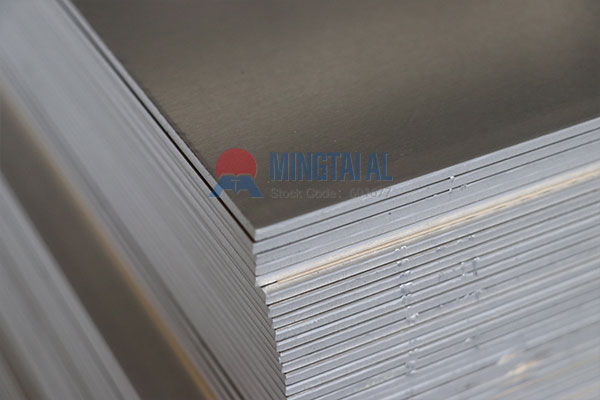
For cooktop surfaces, heat resistance is often the primary concern. But the real issue is not just about withstanding high temperatures—it’s about overall reliability. The aluminum sheet for cooktop applications, specifically 3003 alloy, delivers a well‑rounded balance of thermal conductivity, mechanical strength, and formability that makes it a trusted choice in kitchen equipment manufacturing.
Understanding 3003 Alloy
3003 is an Al‑Mn alloy containing 0.8%–1.5% manganese. Compared with commercially pure aluminum (such as 1100), the addition of manganese improves both strength and corrosion resistance. This alloy cannot be strengthened by heat treatment; its mechanical properties are enhanced through cold working.
- Melting range: 640–655°C.
Although a gas flame can exceed 900°C, the cooktop panel does not come into direct contact with the flame. Heat is transferred through the cookware, so the panel’s working temperature stays far below the melting point.
- Service‑temperature limit for mechanical properties:
Under normal cooking conditions (pan bottom temperatures typically ≤200–250°C), 3003 maintains stable mechanical performance without significant softening.
Thermal Conductivity – The Silent Partner of Heat Resistance
Good thermal conductivity directly reduces local temperature rise and thermal stress, which lowers the risk of distortion. In 3003, conductivity and heat resistance work hand in hand.
Typical thermal conductivity values vary by temper:
- O‑temper (annealed): ~193 W/(m·K)
- H12 temper: ~162 W/(m·K)
- H14 temper: ~159 W/(m·K)
These figures are substantially higher than those of steel (roughly 40–50 W/(m·K)). Faster, more uniform heat distribution means fewer hot spots, better cooking performance, and longer panel life.
Performance Under Repeated Heating and Cooling
Cooktop panels undergo daily thermal cycles, so dimensional stability is critical.
- Linear thermal expansion coefficient: ~23 µm/m·°C.
This expansion is predictable and manageable. With proper design clearance and mounting methods, 3003 panels remain flat over long‑term use.
- Strength retention:
At typical operating temperatures (below 200°C), the loss in tensile strength is limited. The manganese content also provides good corrosion resistance, which is valuable in humid kitchen environments where condensation and spills are common.
3003 vs. Other Alloys – Why It Stands Out
Two comparisons are most frequently asked about:
3003 vs. 1100 (commercially pure aluminum)
- 1100 offers excellent formability and conductivity, but its strength is lower.
- 3003 is notably stronger and more resistant to creep under thermal cycling.
- For cooktops that experience repeated heating and cooling, 3003 is the more dependable option.
3003 vs. 5052 (Al‑Mg alloy)
- 5052 has higher strength, but its thermal conductivity (≈138 W/(m·K)) is significantly lower than that of 3003 (≈190 W/(m·K) in O‑temper).
- For a cooktop panel, heat transfer efficiency is a top priority – and 3003 wins here.
- 3003 also has better formability, making it easier to produce complex panel shapes.
In short, 3003 achieves the highest composite score across heat resistance, thermal conduction, formability, corrosion protection, and cost. That balance is exactly why it has become a benchmark material for cooktop panels.
Selection Guidelines – What to Consider
Choosing the right specification depends on the specific product design:
1. Temper selection
- O‑temper (annealed): Best for deep‑drawing applications where maximum formability is needed.
- H‑tempers (H12, H14, H24): Provide higher strength and rigidity for panels that require extra stiffness.
2. Thickness range
- Typical thicknesses for cooktop panels fall between 0.3 mm and 4.0 mm.
- Thinner gauges improve heat response but reduce structural rigidity; thicker gauges resist deformation better but slow down heat transfer. The right balance depends on the specific cooktop design and load requirements.
Additional processing such as cutting or stamping can be carried out according to specific design needs. We supply high‑quality 3003 aluminum sheet as raw material and do not engage in surface treatment or secondary fabrication.
Practical Insight
When all factors are weighed – thermal stability, conductivity, workability, and long‑term durability – 3003 consistently proves its worth. It does not claim to be the strongest or the cheapest; instead, it offers the most practical combination for cooktop manufacturing. For engineers and product developers aiming for consistent performance in high‑temperature kitchen environments, this alloy has stood the test of real‑world use.
Therefore, when choosing an aluminum sheet for cooktop applications, 3003 remains a reliable, field‑proven option. Mingtai Aluminum has been supplying 3003 sheets that meet international standards, with verified performance in numerous global kitchen projects. Feel free to reach out for technical data and sample support.
FAQ
Q: What maximum temperature can 3003 aluminum sheet withstand?
A: Its melting range is 640–655°C, and for cooktop panels, mechanical properties remain stable under normal cooking temperatures.
Q: Which is better for cooktops – 3003 or 1100?
A: 3003 offers higher strength and better thermal‑cycling resistance, making it the more suitable choice.
Q: How does 3003’s thermal conductivity compare to steel?
A: It is about three to four times higher than steel, enabling faster and more even heat distribution.
Q: What thickness is commonly used for cooktop panels?
A: The usual range is 0.3 mm to 4.0 mm, depending on the required rigidity and thermal response.