6063 aluminum sheet properties
Alloy Composition and Basic Characteristics
6063 aluminum sheet properties make it one of the most balanced alloys in the 6000 series. It belongs to the Al-Mg-Si family (aluminum‑magnesium‑silicon) and is heat‑treatable for improved strength. The primary alloying elements are magnesium (0.45%–0.90%) and silicon (0.20%–0.60%), with aluminum content of at least 97.5%.
What distinguishes 6063 is its excellent combination of moderate strength, good formability, fine surface quality, and strong corrosion resistance. Notably, among heat‑treatable aluminum alloys, the Al‑Mg‑Si series is the only one with no documented stress corrosion cracking – a critical advantage for long‑term service in outdoor or load‑bearing environments.
Key Physical Parameters at a Glance
Material selection often starts with density, melting point, and thermal conductivity – these determine weight savings, temperature limits, and heat‑transfer efficiency. The table below summarizes typical physical values for 6063:
|
Property |
Value |
|
Density |
2.70 g/cm³ |
|
Melting range |
580–660°C |
|
Modulus of elasticity |
69.5 GPa |
|
Thermal conductivity |
197–218 W/(m·K) |
|
Electrical resistivity |
0.031–0.043 (Ω·mm²)/m |
These figures show that 6063 offers light weight, adequate rigidity, and high thermal conductivity, making it suitable for structural supports, heat‑dissipating components, and electrical enclosures.
Mechanical Properties and Temper Selection
Mechanical performance varies significantly with temper (heat treatment). Choosing the right temper depends on the required strength, forming method, and machining requirements.
- 6063‑T5 (air‑cooled after shaping, then artificially aged):
Tensile strength ≥160 MPa, yield strength ≥110 MPa, elongation ≥8%. Suitable for general structural and decorative parts.
- 6063‑T6 (solution heat‑treated, water‑quenched, then artificially aged):
Tensile strength 241 MPa, yield strength 214 MPa, elongation 12%, hardness ~73 HBW. This offers a good balance of strength and toughness for most load‑bearing components.
- 6063‑T651 (T6 plus stretching to relieve internal stress):
Tensile strength ~240 MPa, yield strength ~215 MPa, elongation 12%. Lower residual stress ensures better dimensional stability, making it ideal for precision‑machined parts such as mould bases and inspection fixtures.
For complex bending or deep drawing, the O‑temper (annealed) provides maximum formability at lower strength; the desired strength can be restored by subsequent heat treatment.
Thermal Conductivity Advantage and Typical Heat‑Dissipation Applications
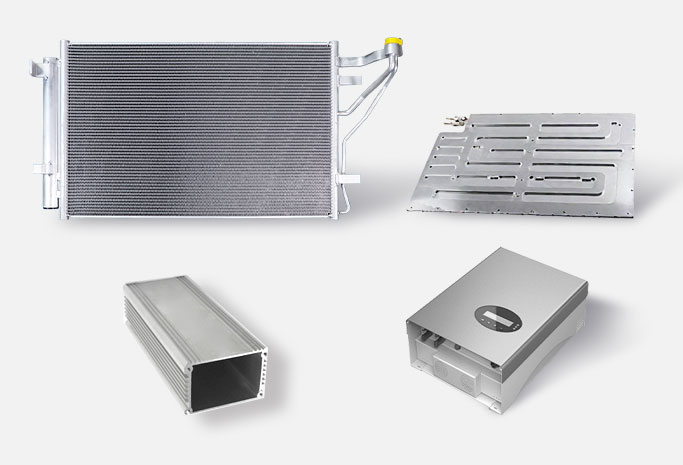
One of the standout features of 6063 is its high thermal conductivity – 197–218 W/(m·K), significantly higher than that of 6061 (about 166 W/(m·K)). This means heat can be transferred more rapidly from the source to the cooling structure. Combined with adequate strength, 6063 heat‑sink designs can be thinner and lighter while maintaining stability under high temperatures or vibration.
Common applications include:
- LED lamp heat sinks and housings
- 5G telecommunication equipment enclosures and cooling modules
- Cooling substrates for power electronics
- Liquid‑cooled plates for battery thermal management systems
- Industrial heat exchangers and radiator fins
6063 vs. 6061 – How to Choose
The most frequent comparison is between 6063 and 6061. The core trade‑off is between strength and surface quality. The table below highlights the key differences:
|
Aspect |
6063 |
6061 |
|
Tensile strength (T6) |
241 MPa |
310–350 MPa |
|
Yield strength (T6) |
214 MPa |
276–310 MPa |
|
Thermal conductivity |
Higher (~200 W/m·K) |
Lower (~166 W/m·K) |
|
Anodized surface finish |
Excellent |
Good |
|
Formability (bend radius) |
Tighter bends possible |
More limited |
|
Typical applications |
Decorative parts, heat sinks, architectural profiles |
Heavy‑duty structural parts, mechanical components |
Selection guideline:
- Choose 6063 when surface appearance, decorative anodizing, or complex bending is a priority.
- Choose 6061 when maximum load‑bearing capacity and fatigue resistance are the main concerns.
Fabrication and Sourcing Considerations
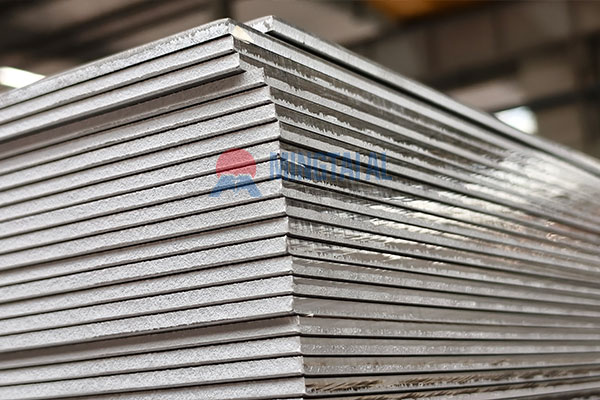
6063 aluminum sheet machines and welds well. When ordering, it is important to specify dimensions, temper, and quality requirements.
Machinability:
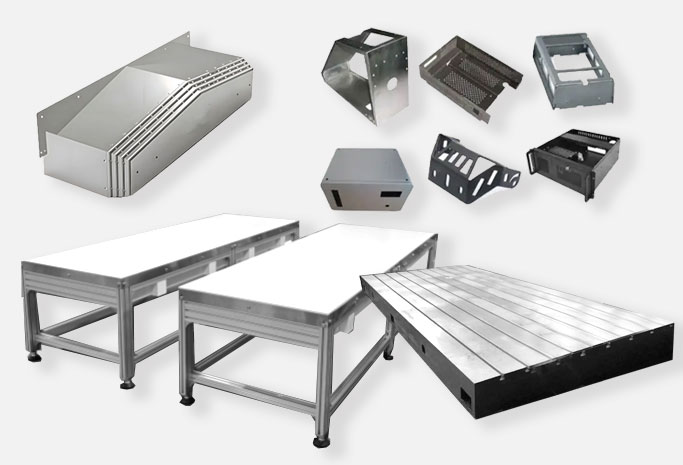
Milling, drilling, bending, and stamping perform smoothly with low tool wear.
Weldability:
MIG and TIG welding are both applicable. Recommended filler wires are 4043 (general purpose, good colour match after anodizing) or 5356 (for higher strength requirements).
Available dimensions:
Thickness from 0.3 mm to 600 mm, width up to 2650 mm, length up to 16000 mm – custom sizes are available.
Quality standards:
Common specifications include ASTM B209, GB/T 3880, or EN 485. Each shipment should be accompanied by a Mill Test Report (MTR) that lists actual tensile strength, yield strength, elongation, and chemical composition.
(Our focus is on the production and supply of aluminum sheet and strip. Surface treatment and secondary processing are not within our scope of work.)
Understanding these 6063 aluminum sheet properties helps in making informed decisions for any project – from prototyping to large‑scale production.
FAQ
Q: What are the main alloying elements in 6063 aluminum?
A: Magnesium (0.45–0.90%) and silicon (0.20–0.60%).
Q: What are the tensile and yield strengths of 6063‑T6?
A: Tensile ~241 MPa, yield ~214 MPa.
Q: What is the thermal conductivity of 6063?
A: Approximately 197–218 W/(m·K), varying slightly with temper.
Q: What is the difference between 6063‑T5 and 6063‑T6?
A: T6 is water‑quenched for higher strength; T5 is air‑cooled with moderate strength and finer surface quality.
Q: Which is better for heat sinks – 6063 or 6061?
A: 6063, due to its higher thermal conductivity.
Q: Can 6063 aluminum be welded?
A: Yes, MIG and TIG are suitable; 4043 or 5356 filler wire is recommended.
Q: What thicknesses are available for 6063 sheet?
A: Typically from 0.3 mm to 600 mm.
Q: Is 6063 corrosion‑resistant?
A: Yes, excellent corrosion resistance, and it is the only heat‑treatable series without stress corrosion cracking issues.
*Mingtai Aluminum offers 6063 aluminum sheets in a wide range of tempers and sizes. Contact us for tailored specifications and supply options for your project.*