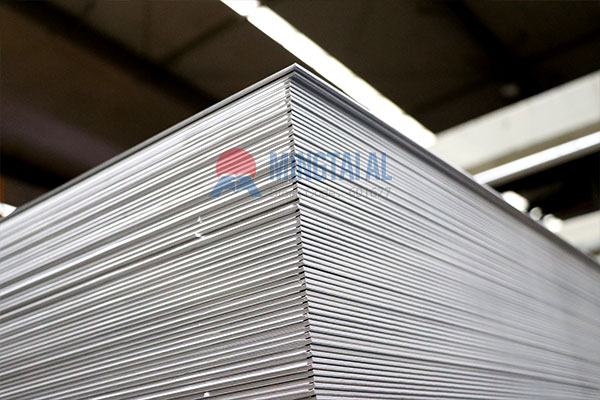
aluminum plate for pcb entry
In PCB manufacturing, drilling accuracy is critical. The aluminum plate for PCB entry—used as an entry sheet on top of the stack—plays an essential role in ensuring precise hole positioning and overall board quality. Its influence, however, is often underestimated.
How Aluminum Plate Affects Drilling Accuracy
The contribution of the entry sheet to drilling precision comes down to four key functions:
- Guiding the drill bit – A flat, stable surface prevents the bit from skidding (drill wander) upon initial contact. This is especially important for small-diameter holes, where even a slight deviation can ruin the board.
- Rapid heat dissipation – Friction generates significant heat during drilling. Aluminum’s thermal conductivity far exceeds that of PCB substrates, so it quickly carries heat away from the bit. Cooler bits wear more slowly and maintain consistent positional accuracy over long production runs.
- Burr suppression – As the drill exits the top copper layer, burrs tend to form. The entry sheet’s surface hardness holds the copper edge firmly, minimising burr formation. The ideal hardness strikes a balance—enough to control burrs, yet not so hard as to accelerate bit wear.
- Surface protection – The sheet also shields the PCB from scratches or indentations that could occur if the drill or debris made direct contact.
Thickness vs. Precision – What Matters
Thickness selection is a decisive factor in hole accuracy. A general rule of thumb: the entry sheet thickness should not exceed the smallest drill diameter.
- For micro‑vias and very fine holes, thinner sheets (around 0.10–0.15 mm) help maintain the drill’s self‑centring effect.
- For standard holes, thicknesses in the 0.15–0.25 mm range are common, but the exact choice depends on the hole size, stack height, and machine parameters.
- Too thin a sheet lacks rigidity and can buckle under impact, causing the bit to drift. Too thick a sheet can delay the bit’s centring action, reducing positioning precision.
In practice, many operations start with a medium thickness (e.g., 0.18 mm) and adjust based on trial results.
Key Performance Indicators for Entry Sheets
A reliable entry sheet must meet several technical criteria. Look for the following:
- Alloy – Most manufacturers prefer 1100 series (minimum 99.00% aluminium). It offers excellent thermal conductivity, moderate hardness, and good formability—all at a reasonable cost.
- Temper – H18 (fully hard) is the standard choice, providing the necessary rigidity and surface hardness for drilling.
- Thickness tolerance – Consistency is crucial. Tight tolerances (within ±0.01 mm, for example) ensure that every sheet delivers the same drill‑bit engagement, avoiding unexpected variations in hole position.
- Surface finish – A smooth surface helps, but not too smooth. A slight, controlled roughness actually improves bit grip and reduces skid risk. Flatness is equally important—any warpage can create gaps between the sheet and the PCB, compromising accuracy.
- Dimensional precision – Width and length tolerances affect how easily the sheet aligns on the drilling machine.
Industry standards such as SJ/T 11641‑2016 specify detailed requirements for classification, inspection, and testing of entry sheets.
Selection Considerations
Choosing the right product involves balancing multiple factors. Consider these points during evaluation:
- Hole diameter – Smaller holes generally call for thinner gauges; larger holes can tolerate a wider range.
- Stack height – When drilling multiple PCBs at once, thickness consistency becomes even more critical to avoid layer‑to‑layer misalignment.
- Machine capability – Spindle speed, feed rate, and tool holder condition all interact with sheet properties. Running test panels with candidate sheets is highly recommended before full‑scale production.
Remember that no single thickness works for every job. A systematic approach—testing, measuring, and adjusting—yields the best long‑term results.
Quick Q&A
Q: Is a thicker sheet always better for accuracy?
A: No—excessive thickness can weaken the drill’s self‑centring effect and actually reduce positional accuracy.
Q: Can any aluminium alloy be used as an entry sheet?
A: Not ideally—high‑purity alloys with moderate hardness (like 1100) are preferred; harder or less pure alloys may accelerate bit wear or impair hole quality.
Q: Should the surface be as smooth as possible?
A: Not necessarily—a very slight roughness helps prevent bit skidding, while an overly polished surface can increase the risk of wander.
Mingtai Aluminum offers high‑quality aluminum plate for PCB entry sheets with precise thickness control and consistent flatness—trusted by manufacturers worldwide for reliable drilling performance.