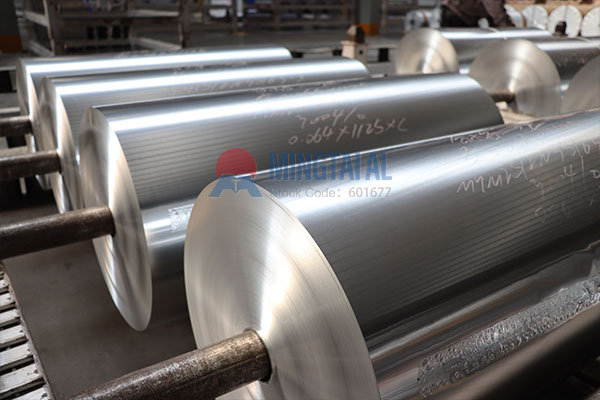
8021 pharmaceutical aluminum foil
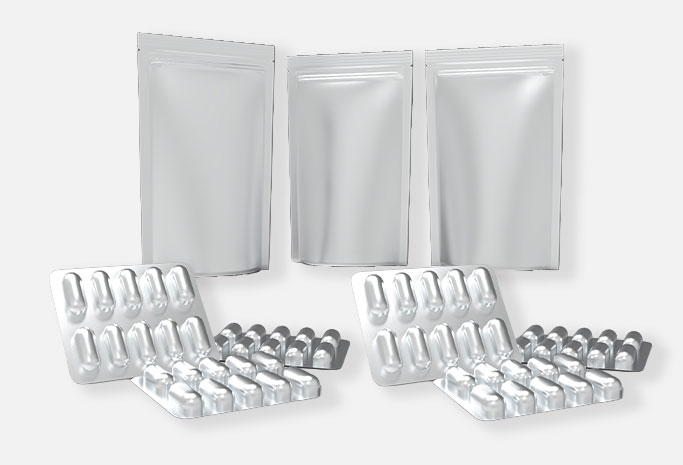
When a solid-dose drug needs a high-barrier package in a cold-form Alu-Alu blister, 8021 pharmaceutical aluminum foil is often the base foil specified for the job.
It is not simply “another pharma foil.” Its role is to form the blister cavity, hold the drug, and keep moisture, oxygen, and light away after deep drawing.
Why aluminum foil is used in drug packaging
Aluminum foil is valued in pharmaceutical packaging for two reasons: barrier performance and formability.
A continuous aluminum layer blocks moisture, oxygen, and light far more effectively than plastic-only blister materials. That matters for drugs that are hygroscopic, oxygen-sensitive, or light-sensitive.
In a standard PTP (press-through-pack) blister, a plastic cavity is sealed with aluminum lid foil. The plastic side still allows some moisture transmission over time.
In an Alu-Alu cold-form blister, the base is a multilayer structure built around aluminum. Both sides of the package are aluminum-based, so the barrier is stronger and more consistent.
This is where 8021 foil fits.
8011 and 8021: similar family, different jobs
Both 8011 and 8021 are used in pharmaceutical packaging, but they are not interchangeable in every structure.
|
Foil grade |
Typical role |
Forming demand |
|
8011 |
PTP lid foil and general pharma foil |
Flat lid sealing; limited deep drawing |
|
8021 |
Cold-form blister base foil |
Deep drawing and cavity forming |
8011 is a workhorse grade for PTP lid foil. It offers good sealing and cost efficiency for ordinary tablets and capsules. However, it is not the preferred choice for deep, irregular cold-form cavities.
8021 is an aluminum-iron alloy with low silicon content, usually supplied in the fully annealed O temper for cold forming. It is designed for the stretching and drawing that Alu-Alu blisters require.
What 8021 pharmaceutical aluminum foil brings to cold-form blisters
The main advantages of 8021 pharmaceutical aluminum foil in cold-form blister structures include:
- Deep-draw formability. The soft O temper supports uniform deformation during cavity forming. Deep cavities, irregular shapes, and larger softgel pockets are less likely to crack or wrinkle.
- Tear and puncture resistance. The alloy design strengthens the foil matrix, helping the package resist sharp tablet edges and handling pressure during transport.
- Stable barrier after forming. Pinhole control is critical. A foil that forms well but develops pinholes after stretching can lose its barrier value. 8021 is selected for its ability to maintain barrier integrity after drawing.
- Composite compatibility. It bonds reliably with nylon/OPA and PVC layers in cold-form structures, supporting strong lamination and sealing performance.
- Corrosion resistance. The dense surface oxide film helps limit interaction with volatile drug components and supports long-term package stability.
There is a trade-off. 8021 is more demanding to produce and costs more than 8011. It belongs in packages where barrier and forming performance are hard requirements, not in every low-cost solid-dose application.
Where 8021 foil is commonly used
Cold-form Alu-Alu packaging with 8021 base foil is often considered for:
- Moisture-sensitive tablets and capsules that need strong protection against humidity.
- Light-sensitive drugs that require an opaque aluminum barrier.
- Large or irregular dosage forms that need deep cavity forming.
- Active ingredients prone to oxidation.
- Products distributed in hot, humid, or export markets where shelf-life stability is critical.
How to evaluate 8021 foil for a blister project
Material selection should look beyond the alloy name. The foil must match the cavity design, the packaging line, and the drug’s sensitivity.
1. Mechanical performance. Check elongation, cup height, tensile strength, and thickness consistency. Uniform elongation in different rolling directions helps reduce one-direction cracking during forming.
2. Pinhole and barrier control. Review pinhole standards, moisture transmission, and oxygen transmission. The key question is not only the flat foil’s barrier, but the barrier after the cavity has been drawn.
3. Surface quality and runnability. The foil surface should be clean and free from oil marks, roll marks, scratches, and dark spots. Consistent wettability supports lamination bond strength, and neat trim edges help stable unwinding on high-speed lines.
4. Pharma compliance. Confirm compliance with applicable pharmaceutical packaging standards, controlled heavy-metal limits, low residue levels, and complete material documentation.
A foil that looks good on paper can still fail if forming, pinhole control, and lamination are evaluated separately. Review them as one package system.
FAQ
Q: Is 8021 foil suitable for PTP lid foil?
A: No—it is mainly used as cold-form base foil, while 8011 is common for PTP lid foil.
Q: Why not use 8011 for deep Alu-Alu cavities?
A: 8011 has limited deep-drawing capacity and may form pinholes or cracks in demanding cavities.
Q: Does 8021 foil need a special temper?
A: Cold-form grades are typically supplied in the soft O temper to support deep drawing.
Q: Can 8021 foil be laminated with plastic films?
A: Yes—it is designed for multilayer cold-form structures with films such as OPA and PVC.
Matching Foil Grade to Packaging Risk
The right foil grade follows the packaging risk. For ordinary PTP lid foil, 8011 can be a practical choice.
For deep-drawn Alu-Alu blisters where moisture, oxygen, light, and pinhole control are critical, 8021 pharmaceutical aluminum foil is the grade to evaluate closely.
Henan Mingtai Al Industry supplies 8021 foil and can provide application-focused technical guidance for pharmaceutical packaging projects.