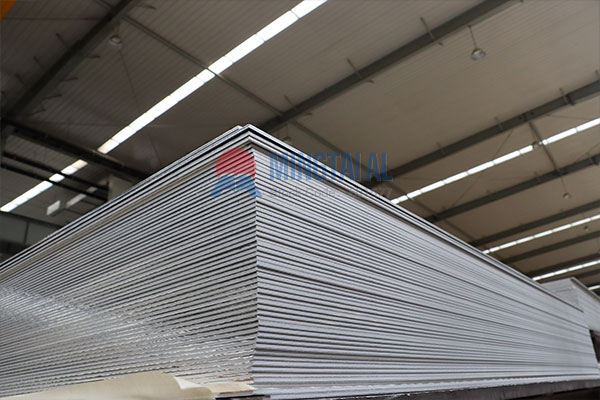
5083 h111 aluminum plate
5083 H111 aluminum plate is a typical 5xxx series Al-Mg alloy (magnesium content 4.0%–4.9%). It is non-heat-treatable, meaning its strength comes from work hardening – and among all non-heat-treatable alloys, 5083 offers the highest strength.
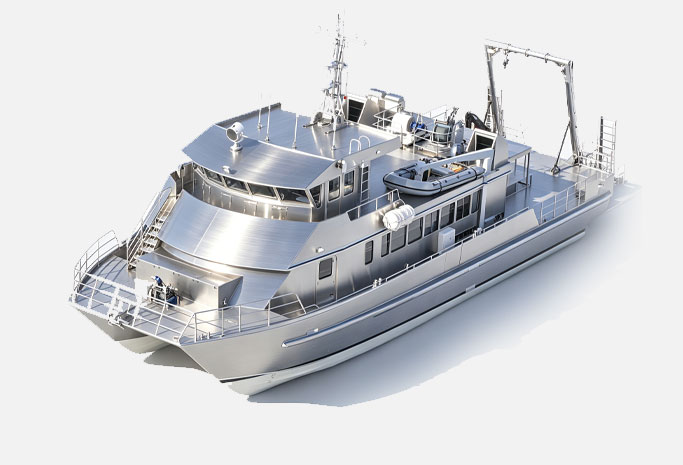
For ship hull construction, common tempers include O, H111, H112, H116, and H321. Each temper delivers different mechanical properties and forming characteristics, so the choice depends on the specific hull component.
What does H111 actually mean?
H111 indicates that the plate has undergone only slight strain hardening after final annealing – less than what is required for H11. In practice, this places H111 right between the fully annealed O temper and the heavily work-hardened tempers.
The real advantage of H111 is balance: it offers higher strength than O temper, but better formability than H116 or H321. That makes it ideal for parts that require bending, curling, or other shaping operations.
Key mechanical properties (BS EN 485‑2:2008)
- Sheet (0.2–6.3 mm): Yield strength ≥125 MPa, tensile strength 275–350 MPa
- Medium plate (6.3–80 mm): Yield ≥115 MPa, tensile 270–345 MPa
- Thick plate (80–120 mm): Yield ≥110 MPa, tensile ≥260 MPa, elongation ≥12%
Physical data: density ≈2.65–2.67 g/cm³, elastic modulus ≈72 GPa, melting point ≈570°C.
*One important limitation* – long‑term service above 65°C is not recommended.
H111 vs. H116 vs. H321 – which one fits your design?
|
Property |
H111 |
H116 |
H321 |
|
Tensile strength |
270–345 MPa |
≥305 MPa |
305–385 MPa |
|
Yield strength |
≥115–125 MPa |
≥215 MPa |
≥215 MPa |
|
Elongation |
≥10–12% |
≥10% |
≥10% |
|
Formability |
Excellent |
Moderate |
Moderate |
|
Corrosion resistance |
Good |
Excellent (specialised for high‑Mg alloys) |
Excellent (stabilised) |
- H116 is specifically designed for 5xxx alloys with ≥4.0% Mg. It has tighter corrosion control and excellent exfoliation resistance.
- H321 undergoes a stabilisation treatment after work hardening, offering stable performance and good intergranular corrosion resistance.
Selection guide: For hull shell plates and bottom structures that are continuously immersed, prefer H116 or H321. For decks, bulkheads, and components that require extensive forming, H111 is the better choice.
Corrosion resistance in seawater
5083 alloys are the standard choice for marine applications mainly because of their outstanding seawater corrosion resistance. The high magnesium content (4.0–4.9%) enables a dense, self‑repairing oxide film that effectively resists chloride attack. In real‑service immersion and splash‑zone tests, 5083 consistently shows much lower corrosion rates than steel – meaning longer hull life and lower maintenance costs.
Weldability
5083‑H111 offers excellent weldability with both MIG and TIG processes. The recommended filler wire is 5183 (alternatives include 5356 and 5556). 5183 is widely used in shipbuilding because it matches the alloy composition and delivers high joint strength. Welded joints retain good mechanical properties, and the heat‑affected zone does not show obvious softening.
Supply and certification overview
Standard dimensions for 5083 H111 plates cover thickness from 3 mm up to 200 mm (some suppliers offer up to 500 mm), widths 1000–2800 mm, and lengths 2000–12000 mm, complying with ASTM B209, ASTM B928, and EN 485.
Mingtai Aluminum supplies 5083 H111 aluminum plate in thicknesses from 1.5 mm to 120 mm, widths up to 3100 mm, and lengths from 1000 mm to 16000 mm. All marine‑grade plates are certified by major classification societies including CCS, ABS, BV, and LR.
*We provide only the base plate material; surface treatment and further processing are not part of our scope.*
FAQ
Q1: What is the main difference between 5083 H111 and H116?
H111 has better formability, while H116 offers higher strength and superior corrosion resistance for immersed service.
Q2: Can 5083 H111 be used directly for the outer hull shell?
Yes, but H116 or H321 are more common for shell and bottom plates; H111 is preferred for decks and bulkheads.
Q3: Does 5083 H111 require heat treatment?
No, it is a non‑heat‑treatable alloy; strength comes solely from work hardening.
Q4: Does welding reduce the strength of 5083 H111?
Welded joints retain good strength with no obvious softening in the heat‑affected zone, especially when using 5183 filler wire.
Q5: What is the maximum service temperature for 5083 H111?
Long‑term exposure above 65°C is not recommended.
Q6: Are classification society certificates required for marine 5083 plates?
Yes, all plates used in ship construction must be certified by societies such as CCS, ABS, BV, or LR.