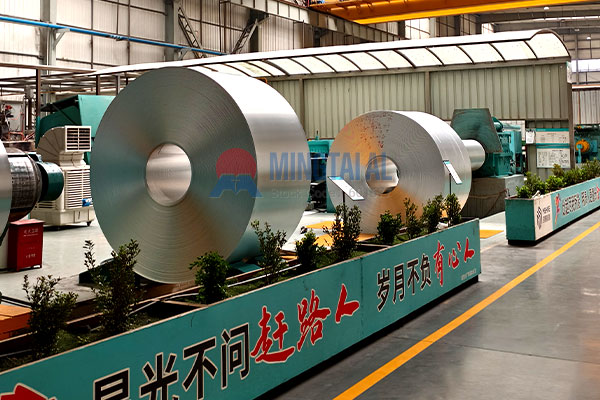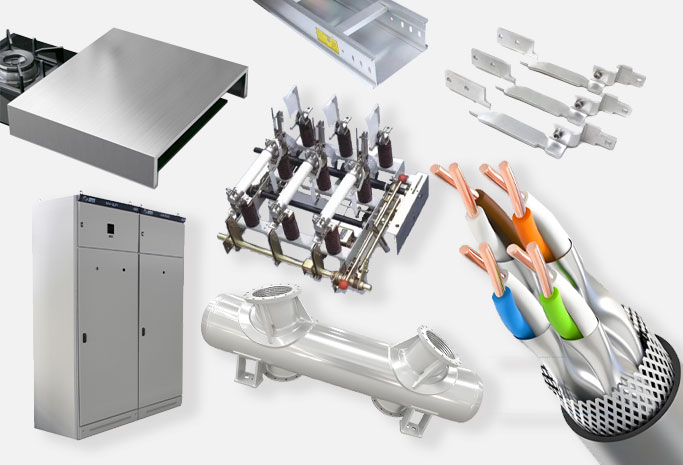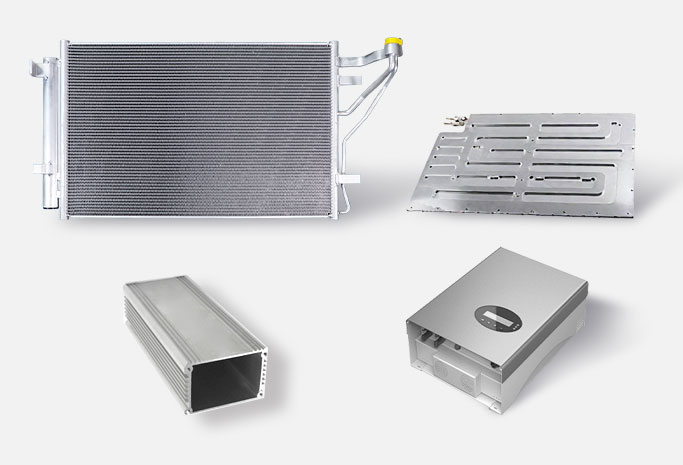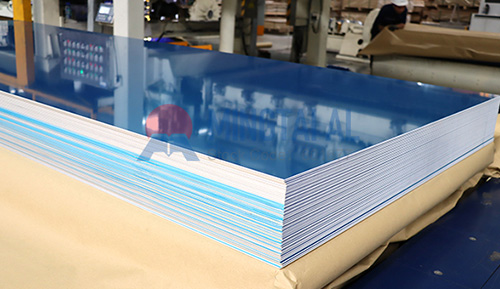
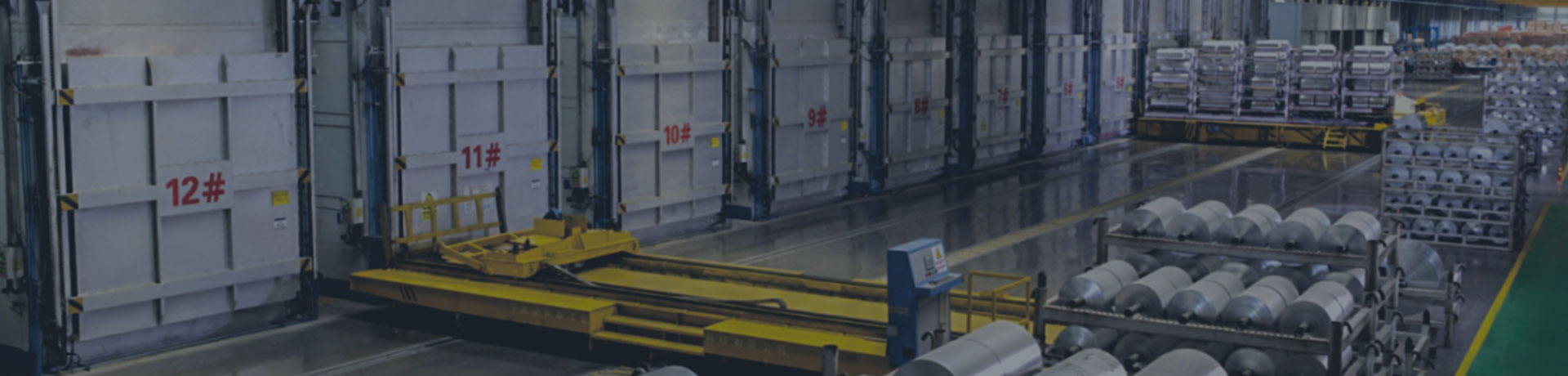
3003 h22 aluminum coil
3003 H22 aluminum coil is one of the most commonly used materials in HVAC manufacturing. It belongs to the Al‑Mn (aluminum‑manganese) series, with manganese content typically around 1.0%–1.5%. Compared to 1100 pure aluminum, this alloy offers about 20% higher strength while retaining excellent formability and corrosion resistance. That combination makes it a natural choice for heat exchanger fins, evaporator and condenser coils, ductwork, and other HVAC components. The H22 temper, in particular, strikes the best balance between strength and formability among all 3003 variants.
What Does H22 Temper Mean?
H22 stands for “strain‑hardened and partially annealed.” Breaking it down:
- H – the material has been cold‑worked (strain‑hardened) to increase strength.
- The first “2” – after cold working, it undergoes partial annealing or stabilization to relieve internal stresses and improve performance consistency.
- The second “2” – the hardness level is quarter‑hard, sitting between the fully soft (O temper) and fully hard (H18/H28) states.
In plain terms: H22 is stronger than O temper, yet much more formable than fully hard tempers. Since 3003 is a non‑heat‑treatable alloy, strength can only be increased through cold working – and H22 is the ideal outcome of that process for most HVAC forming needs.
Formability Specs: What Matters for HVAC Forming
For stamping, bending, and roll‑forming HVAC parts, three properties are the most critical:
- Tensile strength – typically 120–160 MPa in the H22 temper. This level provides enough structural integrity for fins and duct components without making the material too hard to form.
- Yield strength – around 94 MPa. This determines the point at which the material starts to deform permanently. H22’s moderate yield strength minimises springback during forming, while still offering good resistance to deformation in service.
- Elongation – depends on thickness. For thin gauges (0.2–0.5 mm), elongation is at least 6%; for medium gauges (0.5–1.5 mm), at least 7%; and for thicker material (up to 3 mm), 8% or more. Higher elongation means the material can undergo more plastic deformation before cracking – essential for complex fin patterns and collar‑forming operations.
Bending Performance: How Small Can You Bend?
HVAC components often require tight bends and flanges. H22 performs well in this area. The minimum bend radius is related to the material thickness (t):
- Thickness ≤ 0.5 mm → 0t (can be folded completely)
- Thickness 0.5–1.5 mm → 0.5t
- Thickness 1.5–6.0 mm → 1.0t
A practical rule of thumb: for 90° cold bending, the recommended minimum radius is about 1× thickness. For best results, bend across the rolling direction (transverse to the grain) – this significantly reduces the risk of cracking.
With its moderate hardness and excellent ductility, H22 supports stamping, bending, and even deep drawing without failure. In high‑speed fin stamping and flanging, the material runs consistently, with minimal issues like cracking, wrinkling, or fin collapse.
H22 vs. O vs. H14: Which Temper Fits Your Application?
All three tempers are based on the same 3003 alloy, but their performance differs markedly.
|
Temper |
Characteristics |
Best suited for |
|
O (annealed) |
Softest, highest ductility, lowest strength |
Deep drawing, complex shapes, extreme forming |
|
H22 (¼‑hard, partially annealed) |
Balanced strength and formability |
Parts that require moderate forming and moderate strength |
|
H14 (½‑hard) |
Higher strength, slightly lower formability |
Structural components with simple forming requirements |
What makes H22 unique – it offers higher strength than O temper, yet is easier to bend and stamp than H14, reducing the risk of cracking. For high‑volume HVAC fin production that demands both continuous forming and some structural rigidity, H22 is often the optimal choice.
Typical HVAC Applications
In heating, ventilation, and air‑conditioning systems, this alloy is used for:
- Evaporator and condenser fins
- Heat exchanger fin stock
- Ventilation ductwork components
- Cooling system parts
Why choose it? Several practical reasons stand out:
- Good thermal conductivity – aluminium’s thermal conductivity is around 180–190 W/(m·K), sufficient for most heat‑exchange requirements.
- Strong corrosion resistance – performs well in humid environments and in contact with condensate.
- Excellent weldability – can be joined using conventional methods such as MIG welding.
- Consistent quality for high‑speed production – tight thickness and width tolerances ensure stable running on automated roll‑forming and stamping lines.
A Few Practical Processing Notes
3003 H22 coils can be fed directly into stamping, bending, or roll‑forming equipment – no additional heat treatment is required, because the alloy is not heat‑treatable. Common thickness ranges are 0.2–8.0 mm, with widths up to 2650 mm; fin stock for HVAC often uses thinner gauges (0.04–0.20 mm).
This article focuses on the base material properties of 3003 H22 aluminum coil; surface treatment and secondary processing are separate considerations and are not covered here.
For reliable supply of 3003 H22 aluminum coil with consistent mechanical properties and stable quality, Mingtai Aluminum is a trusted source for HVAC manufacturing.-
FAQ
Q: What is the minimum bending radius for 3003 H22 aluminum coil?
A: For thickness up to 0.5 mm, it can be bent to 0t; for 0.5–1.5 mm, 0.5t; and for 1.5–6.0 mm, 1.0t.
Q: Can 3003 H22 aluminum coil be used for high‑speed fin stamping?
A: Yes – H22 offers stable mechanical properties that support high‑speed stamping, flanging, and stretching with low risk of cracking or fin collapse.
Q: What is the difference between 3003 H22 and 3003 O temper?
A: H22 has higher strength than O temper, while O temper provides maximum ductility for deep drawing and complex forming.
Q: Does 3003 H22 require heat treatment before forming?
A: No – 3003 is a non‑heat‑treatable alloy, and H22 temper is ready for forming as supplied.
Q: Is 3003 H22 suitable for welded HVAC components?
A: Yes – 3003 aluminium alloy offers good weldability and can be joined by conventional welding methods.