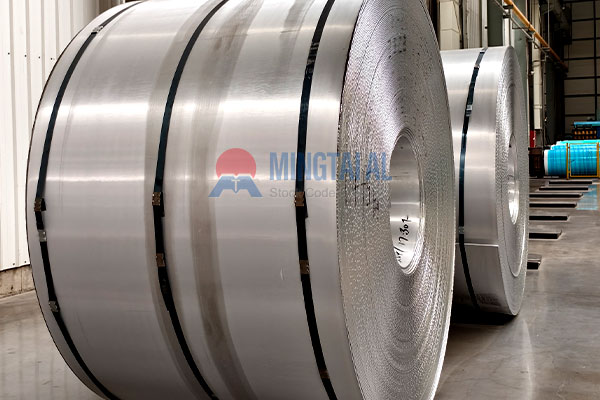
3003 Aluminum Coil
A 3003 Aluminum Coil can carry the same alloy designation and still behave very differently on a press. The chemistry may look identical on a mill certificate, but the production route changes how the metal stretches, flows, and survives a deep draw. For battery housings, cookware, pressure vessels, and complex stamped parts, that difference often decides whether production runs smoothly or scrap piles up.
3003 in Plain Terms
3003 is an aluminum-manganese alloy. It is not strengthened by heat treatment; strength comes from cold work. Its main advantages are good corrosion resistance, good weldability, and strong forming behavior. That combination is why 3xxx-series stock is common wherever moisture, coolant, or electrolyte contact is part of the service environment.
But the alloy name alone does not tell you whether a coil is right for a demanding forming job. The upstream process does.
Why the Production Route Matters
Hot Rolled: Uniform Grain, Predictable Stretch
In the hot rolled route, a direct-chill ingot is homogenized and then hot rolled at elevated temperature. The thermal and deformation cycle allows the grain structure to recrystallize into fine, uniform grains. The result is a sheet with more consistent behavior in every direction.
Continuous Cast: Lower Cost, Narrower Forming Window
In the continuous cast route, molten metal solidifies between rolls into a thin strip, which is then cold rolled to final gauge. It is a shorter, lower-cost flow. However, rapid solidification can leave a directional grain structure and uneven recrystallization during later annealing. That makes the material less forgiving in severe forming.
|
Behavior |
Hot Rolled 3003 |
Continuous Cast 3003 |
|
Grain structure |
Uniform and fine |
More directional |
|
Deep drawing |
Excellent resistance to tearing and earing |
Suitable for light forming; less stable in severe draws |
|
Surface consistency |
Uniform, fewer segregation streaks |
Can show rolling marks and texture variation |
|
Thickness stability |
Tight and consistent across the coil |
More sensitive to process window |
|
Cost position |
Higher processing cost |
Lower entry cost |
Where Each Route Fits
Hot rolled 3003 is the better match for:
- Multi-stage deep drawing
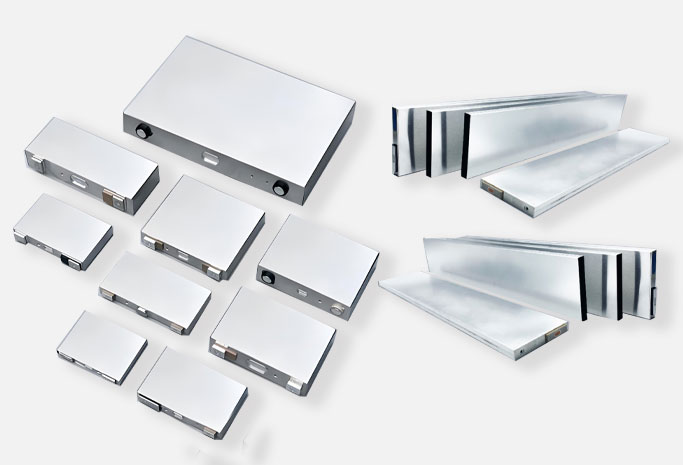
- Battery housings and liquid-cooling plates
- Pressure vessels and fuel tanks
- Deep-formed food containers and cookware
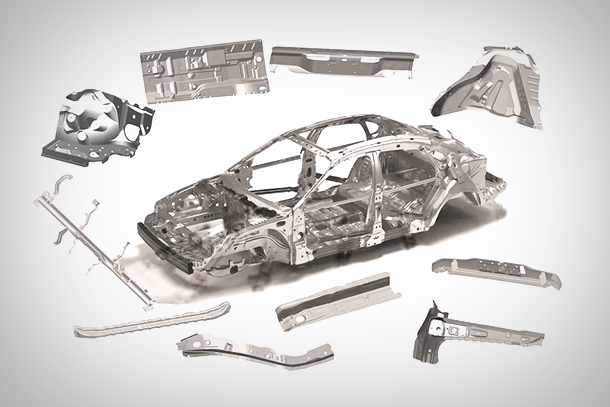
- Complex stamped sheet metal where cracking or leakage is a risk
Continuous cast 3003 is often a reasonable choice for:
- General insulation jacketing
- Painted architectural sheet with modest forming
- Simple equipment enclosures
- Shallow-bent covers and low-cost brackets
The key is not to ask continuous cast stock to do a job that requires isotropic stretch. When the part has a deep cavity, a tight corner radius, or a multi-station transfer press, material choice should follow forming severity rather than purchase price alone.
Battery Housings Raise the Bar
Prismatic cell housings are a useful test case because the forming sequence is unforgiving.
Many square shells are made by multi-stage deep drawing, sometimes followed by ironing, to form a seamless cup and eliminate a welded bottom seam. That design reduces leak risk, but it also demands a coil with enough elongation, low earing tendency, and a surface clean enough that no inclusion becomes a leak path.
Temper choice matters. H14 is common for this work. It sits between soft O temper and harder H18, giving enough stiffness for the finished shell while retaining the plasticity needed for the draw.
Hot rolled stock brings predictable deformation. A hot rolled 3003 coil in H14 offers more consistent flow across the blank, which helps produce more uniform sidewall thickness and fewer corner cracks on high-speed automated presses.
Secondary benefits also count. The manganese-rich surface oxide resists electrolyte attack, and aluminum’s thermal conductivity helps move heat away from the cell stack. These are not forming properties, but they influence whether the housing performs as a protective structure rather than just a container.
Practical Checks Before Ordering a 3003 Aluminum Coil
1. Confirm actual temper properties. Check the mechanical properties on the coil, not just the nominal temper. Small shifts in yield strength can change springback and draw behavior.
2. Ask about earing tendency. For battery housings and deep cups, production history on similar geometries is more useful than a generic data sheet.
3. Set a clear surface standard. Slivers, inclusions, and roll marks that are cosmetic on a painted panel can become leak initiation sites on a drawn housing.
4. Review thickness profile. Gauge variation across the width affects draw clearance and wall thickness distribution.
5. Check edge quality and coil set. Clean slit edges and controlled coil set reduce misfeed and die wear on high-speed lines.
FAQ
Q: Is hot rolled 3003 always more expensive than continuous cast 3003?
A: It usually carries a higher coil price, but better yield on deep-drawn parts can narrow the total cost gap.
Q: Can continuous cast 3003 be used for battery housings?
A: It may suit less demanding geometries, but hot rolled stock is more reliable for multi-stage deep-drawn prismatic shells.
Q: What temper is typical for deep-drawn 3003?
A: H14 is common because it balances formability with enough stiffness for the finished part.
Q: Does 3003 work well for welded assemblies?
A: Yes, its good weldability makes it suitable for housings, heat-transfer components, and fabricated enclosures.
Matching the Coil to the Forming Job
The right 3003 coil is the one that matches the draw ratio, surface requirement, and production speed of the actual part. For severe forming, hot rolled stock is usually the safer starting point; for simple bends and painted panels, continuous cast stock can be cost-effective.
Henan Mingtai Aluminum Industry produces hot rolled 3003 Aluminum Coil for deep-drawn battery housings and other forming-critical parts, with stable temper, clean surfaces, and reliable coil-to-coil consistency.