1235 vs 1060 aluminum foil
When it comes to 1235 vs 1060 aluminum foil, the decision often depends on whether your application is a battery or a capacitor. Both are 1xxx series pure aluminum foils, yet their differences in purity and mechanical properties lead to distinct uses. This article breaks down the selection from four key angles.
Chemical Composition – The Foundation of Performance
Both grades belong to the 1xxx series, but their purity levels differ.
- 1235 aluminum foil has a minimum aluminum content of 99.35%, with Fe+Si controlled below 0.65%. Its slightly wider impurity tolerance makes production more cost‑effective.
- 1060 aluminum foil contains at least 99.6% aluminum, with strict limits on iron (≤0.35%), silicon (≤0.25%), and copper (≤0.05%).
That 0.25% difference in purity directly determines where each alloy excels.
Higher‑purity 1060 delivers more stable performance in electrochemical reactions, while 1235 offers a balanced mix of properties at a competitive cost.
Mechanical Properties – Strength vs Formability
Batteries and capacitors demand completely different mechanical traits from aluminum foil.
For battery current collectors, strength is the priority.
Lithium‑ion battery cathodes typically require tensile strength above 180 MPa. 1235‑H18 falls in the range of 170–200 MPa, meeting the requirement comfortably. Beyond strength, the foil must have a clean surface, minimal thickness variation, and good wettability (≥32 dynes) to ensure proper adhesion of the active material.
For capacitor electrodes, purity and electrochemical stability matter more.
Capacitor foils need to form a uniform oxide layer as the dielectric. Impurities like copper, iron, and silicon can disrupt anodization uniformity and voltage endurance. Higher‑purity aluminum produces a more stable oxide film with lower leakage current. Additionally, capacitor foils require good flexibility during winding and slitting to prevent breakage or wrinkling.
In short: batteries want strength + surface cleanliness; capacitors want purity + electrochemical stability.
Application Scenarios – Where Each Alloy Shines
For Battery Applications – 1235 is the mainstream choice
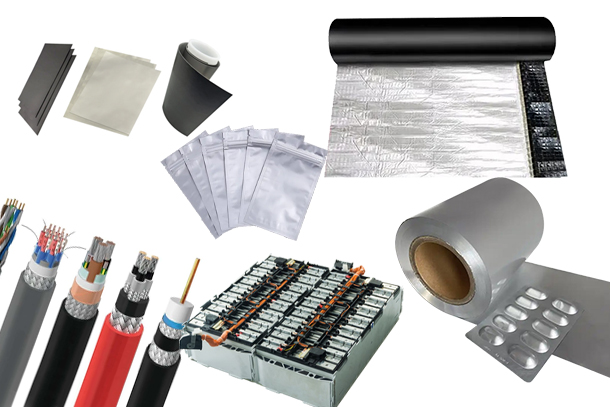
1235 foil is widely used as the positive current collector in lithium‑ion batteries. Its advantages include:
- Adequate strength (170–200 MPa in H18 temper)
- Stable surface quality with good wettability
- A favourable balance between performance and cost
This makes 1235 the go‑to option for most battery projects.
For Capacitor Applications – 1060 is the preferred base material
1060 foil is the primary raw material for aluminum electrolytic capacitor electrodes. Common thicknesses range from 0.05–0.11 mm for anode foils and 0.02–0.05 mm for cathode foils. The high purity of 1060 ensures:
- More uniform and dense oxide film formation
- Lower leakage current
- Stable electrochemical performance over time
Thus, 1060 dominates the capacitor sector.
Selection Guide – A Quick Reference Table
|
Comparison Aspect |
1235 Aluminum Foil |
1060 Aluminum Foil |
|
Aluminum content |
≥99.35% |
≥99.6% |
|
Core strengths |
Balanced strength and formability |
High purity, electrochemical stability |
|
Typical tempers |
H18 |
O, H14, H18 |
|
Primary application |
Li‑ion battery cathode current collector |
Electrolytic capacitor electrode base |
|
Decision keywords |
Strength, surface quality, cost |
Purity, oxide film quality, leakage current |
Choose 1235 when:
- You are working on lithium‑ion battery current collectors
- You need sufficient strength and a clean surface
- You are looking for cost‑effective production for large volumes
Choose 1060 when:
- You are producing aluminum electrolytic capacitors (anode or cathode)
- Your application demands high purity and low leakage
- You will perform formation treatment (anodization) to build the oxide layer
Thickness and Supply – Practical Considerations
Thickness ranges overlap but differ slightly between the two grades.
Typical 1235 foil thickness spans from 0.006 mm to 0.2 mm, while 1060 is commonly available from 0.016 mm to 0.2 mm.
Our production covers thicknesses above 20μm, meeting the conventional needs of both battery and capacitor applications.
Temper choices:
- H18 (full hard) – high strength, ideal for battery current collectors
- O (annealed/soft) – good flexibility, suitable for capacitor winding
- H14 (intermediate) – often used for battery case materials
Choosing the Right Alloy
Both 1235 and 1060 are excellent 1xxx series aluminum foils, but they serve different purposes.
1235 stands out for battery cathode current collectors because of its reliable strength, surface quality, and cost efficiency. 1060 takes the lead in capacitor electrodes thanks to its higher purity and better electrochemical stability.
So, in the 1235 vs 1060 aluminum foil debate, the choice boils down to two questions: Is your application a battery or a capacitor? Do you prioritise strength or purity? Once you answer those, the right alloy becomes clear.
As a professional aluminum foil manufacturer, Henan Mingtai Aluminum offers high‑quality 1235 and 1060 aluminum foil in thicknesses above 20μm, with stable quality and reliable supply for battery and capacitor applications worldwide.
FAQ
Q1: What is the main difference between 1235 and 1060 aluminum foil?
A: 1060 has higher purity (≥99.6% vs ≥99.35%), while 1235 offers better strength and formability for battery use.
Q2: Which alloy is better for lithium battery current collectors?
A: 1235 is preferred because its tensile strength (170–200 MPa) and surface quality meet battery requirements well.
Q3: Which alloy is better for aluminum electrolytic capacitors?
A: 1060 is the better choice due to its high purity, which ensures stable oxide formation and lower leakage current.
Q4: Can 1235 and 1060 be used interchangeably?
A: Not recommended – each is optimised for different needs: 1235 for battery strength, 1060 for capacitor purity.