aluminum foil for heat shield
Radiant heat is often the most difficult part of thermal management to control. Aluminum foil for heat shield applications works mainly by reflecting infrared radiation and keeping its own emissivity low, so more heat is sent back toward the source instead of being absorbed and re-radiated. That is why foil is widely used in automotive, aerospace, and industrial heat shielding.
Why Aluminum Foil Works in Heat Shields
Aluminum foil offers a practical combination of properties:
- High reflectivity – it reflects a large portion of infrared radiation.
- Low emissivity – it releases very little heat from its surface as radiation.
- Lightweight – it is much lighter than many metal shielding materials.
- Flexibility – it can be wrapped, bent, and fitted to complex shapes, and it works well in layered structures.
When radiant heat is the main transfer mode, foil often performs better than materials designed only for conduction or convection.
What Affects Thermal Reflectivity
Surface Condition
Cleaner and smoother foil surfaces generally reflect better. Oxidation, oil, and roughness can reduce infrared performance.
Alloy and Purity
Pure aluminum foil usually has better reflectivity. Added alloying elements can improve strength or corrosion resistance, but they may also change reflection behavior.
Thickness and Structure
Thickness is not a direct indicator of reflectivity. As long as the aluminum layer fully covers the surface, it can act as a radiant barrier. Thickness mainly affects strength, formability, and installation.
Common Alloy Choices
- 1050 and 1060 – pure aluminum grades with good reflectivity and excellent formability.
- 1100 – often used in building insulation and HVAC ducting.
- 3003 and 3105 – better corrosion resistance for more demanding environments.
- 5052 – higher strength for shields that need some structural support.
- 8011 and 8079 – good high-temperature stability, common in automotive thermal parts.
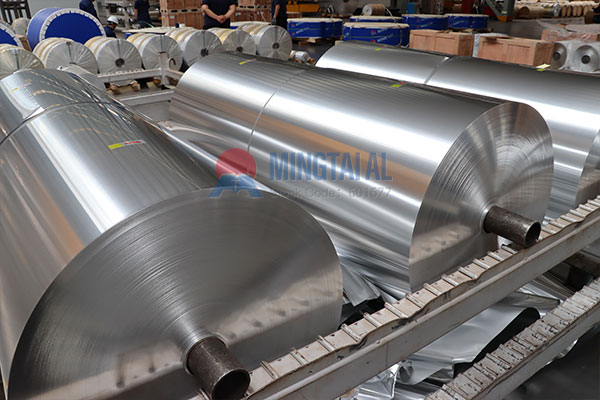
Please note: Mingtai focuses on aluminum foil rolling and does not perform surface treatment or further processing; those steps are usually handled by specialized manufacturers further down the supply chain.
Typical Applications
Automotive Thermal Management
Foil reflects radiant heat in engine compartments, exhaust areas, and around brakes and wire harnesses, helping protect nearby plastic parts, pipes, and sensors.
Aerospace
In multilayer insulation, foil acts as a low-emissivity radiant barrier and is alternated with fiber insulation layers to reduce radiant heat transfer.
Building and Industry
Roof radiant barriers, HVAC duct insulation, and industrial pipe or equipment insulation use foil to improve system efficiency.
Heat-Shield Materials Compared
There is no single “best” heat-shield material. The right choice depends on the working conditions. When radiant heat dominates, aluminum foil for heat shield applications is often the first option because it balances reflection, weight, cost, and formability well.
- Copper foil – also reflects infrared well, but it is heavier and more expensive, so it is usually reserved for special needs.
- Stainless steel – strong, heat-resistant, and corrosion-resistant, but usually less effective at reflecting radiant heat.
- Ceramic fiber and ceramic insulation – excellent at high temperatures and blocking conductive heat, but limited in radiant reflection; often combined with foil.
- Aluminized film – flexible and often lower in cost, but its thin aluminum layer may not match foil in durability or long-term stability.
- Aluminum foil – lightweight, easy to shape, and effective in radiant-heat environments.
If the heat source is mainly radiant, foil is often the first material to consider. If high temperature, corrosion, wear, or structural load is also present, a combination of foil and other materials is usually more suitable than foil alone.
How to Specify the Right Foil
1. Identify the main heat-transfer mode – choose foil first for radiant heat; use a layered design for conduction or convection.
2. Check temperature and duration – for continuous high heat, select a more stable alloy or combine foil with ceramic fiber or other insulation.
3. Review the environment – humid or corrosive conditions call for better corrosion resistance; clean indoor use may allow pure aluminum grades.
4. Choose the structure – the choice among single-layer foil, foil with fiber cloth, and multilayer insulation depends on space, installation, and weight limits.
5. Set the dimensions – thickness follows strength, forming, and installation needs; width and coil weight should match downstream equipment.
6. Clarify processing limits – surface treatment, lamination, and slitting are usually completed by specialized manufacturers further down the supply chain.
Define the operating conditions first, then choose the alloy, and set the dimensions last. That order is more useful than comparing price alone.
FAQ
Q1: How does aluminum foil heat shielding reduce heat?
A: It mainly relies on high infrared reflectivity and low emissivity to reduce radiant heat transfer.
Q2: Does thicker foil always reflect more heat?
A: No; thickness mainly affects strength and formability, while reflectivity depends more on surface condition and material purity.
Q3: Which alloys are common for heat-shield foil?
A: 1050, 1060, 1100, 3003, 5052, and 8011 are common choices.
Q4: Can foil be used alone as a heat shield?
A: Yes, but in high-temperature or complex environments it is often combined with fiber cloth, insulating paper, or other layers.
If you are looking for a reliable supply of heat-shield aluminum foil, Henan Mingtai Aluminium Industrial Co., Ltd. offers multiple alloy grades and custom specifications. Mingtai focuses on foil rolling; surface treatment and further processing are usually completed by specialized manufacturers further down the supply chain.