1050 aluminum foil purity
What Does “Purity” Mean for 1050 Aluminum Foil?
The 1050 aluminum foil purity is defined as a minimum aluminum content of 99.5% under international designation rules. This grade belongs to the 1000 series of pure aluminum, and the digits “50” in the name indicate that the alloy must contain at least 99.5% aluminum to be qualified. The Chinese standard GB/T3880‑2006 also confirms this requirement.
In practice, this means total impurities are strictly limited to less than 0.5%. The main impurity elements and their maximum limits are: silicon (Si) ≤ 0.25%, iron (Fe) ≤ 0.4%, copper (Cu) ≤ 0.05%, magnesium (Mg) ≤ 0.03%, and zinc (Zn) ≤ 0.05%. Such tight control over impurities is what gives 1050 foil its unique advantages across many industrial fields.
What Properties Does This Purity Deliver?
A 99.5% purity level directly influences several key performance characteristics of 1050 foil:
- Electrical conductivity – reaches about 57‑58% IACS, making it suitable for electrical applications.
- Thermal conductivity – roughly 230 W/(m·K), which supports good heat dissipation.
- Corrosion resistance – forms a dense, protective oxide film on the surface in air, effectively preventing further oxidation.
- High formability – elongation can reach around 25%, allowing easy stamping, bending, and deep drawing.
- Reflectivity – a polished surface can reflect over 80% of visible light, useful for lighting fixtures and reflectors.
All these properties – conductivity, thermal transfer, corrosion resistance, and plasticity – are secured by the high purity level. Higher purity ensures more stable and reliable performance in service.
Which Industrial Applications Use 1050 Foil?
Thanks to its balanced properties, 1050 aluminum foil finds wide use in several sectors:
Electrical applications (driven by conductivity)
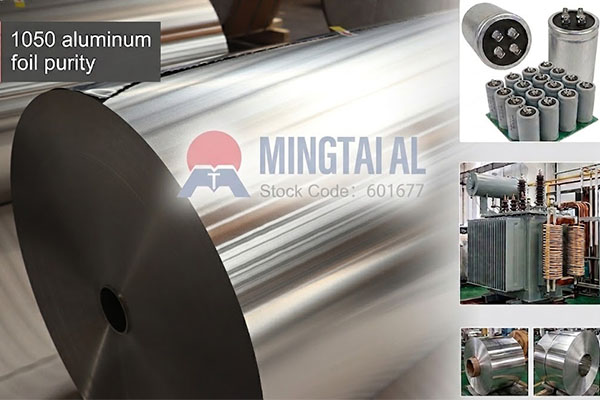
Transformer windings are a major use case. The foil needs high conductivity, softness, and a smooth surface – all of which 1050 provides. It is also used in electrolytic capacitor electrodes and cable wraps.
Thermal management (driven by thermal conductivity)
Heat sinks and heat exchangers benefit from the foil’s efficient heat transfer. It is commonly seen in industrial equipment that requires reliable cooling.
Chemical and corrosion‑resistant environments
Good corrosion resistance makes it suitable for chemical instruments, containers, and other applications where exposure to corrosive media is a concern.
Packaging and reflective products
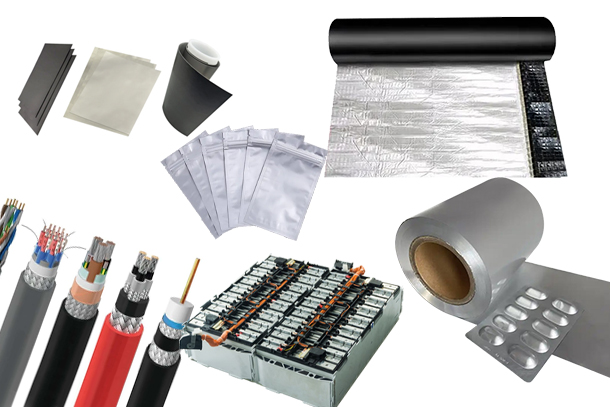
Food packaging, and aluminum gaskets often use 1050 foil. Reflective sheets, lighting reflectors, and decorative items also rely on its bright surface.
How to Choose Between 1050, 1060, and 1100?
All three are 1000‑series pure aluminum grades, but they differ in purity and impurity control. The table below summarizes their differences:
|
Grade |
Aluminum Content |
Key Features |
Best‑Suited Applications |
|
1050 |
≥ 99.5% |
Balanced corrosion resistance and workability |
Chemical instruments, heat exchangers, welded parts, cookware |
|
1060 |
≥ 99.6% |
Higher conductivity and corrosion resistance |
Capacitors, cables, electrical equipment |
|
1100 |
≥ 99.0% |
Superior formability for complex shaping |
Deep‑drawn parts, intricate forming, some heat sinks |
Purity order: 1060 > 1050 > 1100. Among them, 1050 offers the best compromise between purity and workability, which is why it is the most commonly used series in general industry.
What to Consider When Purchasing 1050 Foil?
Common thicknesses for 1050 foil range from 0.014 mm to 0.2 mm, with widths up to 1700 mm. Available tempers include O (annealed), H18, H19, H22, H24, etc.
Quality foil should have a clean, smooth surface free from corrosion, scratches, wrinkles, or other defects. Because 1050 does not require alloying elements, its production process is simpler, making it more cost‑effective compared to alloyed aluminum foils.
In summary, the 1050 aluminum foil purity of 99.5% is not just a number – it is the foundation of reliable conductivity, thermal transfer, corrosion resistance, and formability. From transformers to heat exchangers, and from packaging to reflectors, this grade delivers dependable performance at a competitive cost.
*For consistent 1050 aluminum foil with stable purity and quality, Henan Mingtai Al offers solutions tailored to your industrial requirements.*
FAQ
Q1: What is the minimum purity of 1050 aluminum foil?
A: It must contain at least 99.5% aluminum according to international standards.
Q2: Which impurities are limited in 1050 foil?
A: Main limits are silicon ≤0.25%, iron ≤0.4%, copper ≤0.05%, magnesium ≤0.03%, and zinc ≤0.05%.
Q3: What are the primary uses of 1050 foil?
A: Transformer windings, capacitors, heat exchangers, food packaging, chemical containers, and reflectors.
Q4: How does 1050 compare with 1060?
A: 1060 has higher purity (≥99.6%) and better conductivity, while 1050 is more cost‑effective and widely used.
Q5: Is 1050 foil electrically conductive?
A: Yes, its conductivity is about 57‑58% IACS, suitable for many electrical applications.
Q6: What thicknesses are available?
A: Typical foil thickness ranges from 0.014 mm to 0.2 mm, and widths up to 1700 mm.